
Let me answer the headline question before anything else: there is no such thing as fireproof workwear. "Fireproof" implies a fabric that cannot burn, and no wearable material clears that bar — every textile has a burning point. What the industry actually sells is flame-resistant (FR) clothing: fabric that resists ignition, self-extinguishes once the flame source is pulled away, and won't melt or drip onto your skin. That is a real, measurable, and lifesaving property — but it is finite. So when a listing or a salesperson says "fireproof," treat it as marketing shorthand at best and a dangerous misunderstanding at worst. This guide explains the difference, the standards that define it, and exactly where FR protection runs out.
Key Takeaways
- Nothing wearable is fireproof. Every fabric has a burning point, so the correct terms are flame-resistant and arc-rated — see what FR clothing actually is.
- Flame-resistant means self-extinguishing, not non-flammable. FR fabric resists ignition and won't melt, but it can still char and degrade under enough heat.
- "Fire-resistant," "fire-retardant," and "FRC" get used interchangeably in catalogs, but technically fire-retardant is the chemical treatment while flame-resistant describes the finished fabric's behavior — more in inherent vs treated FR.
- FR protection is finite and hazard-specific. It's rated by time, cal/cm², and the type of hazard — flash fire (NFPA 2112) is not the same as arc flash (NFPA 70E / ASTM F1506); compare them in arc-rated vs flame-resistant.
- Contamination kills protection. Oil, grease, or solvents soaked into FR fabric can ignite and burn even though the fabric underneath is still FR.
Why "Fireproof" Is the Wrong Word
"Fireproof" is a misnomer in workwear because no fabric is truly fireproof — every material has a burning point, and once you exceed it, the material will degrade, char, or combust. The terms the industry actually uses are flame-resistant (FR) and arc-rated (AR). The slip is everywhere, even among reputable brands: Carhartt's own catalog uses "fireproof jeans" colloquially in its URLs while the garments are, technically, flame-resistant — not fireproof (Carhartt FR pants catalog).
This isn't pedantry. The word "fireproof" sets a mental expectation — "I'm wearing this, so fire can't hurt me" — that the garment cannot live up to. FR clothing buys you seconds to escape and dramatically reduces burn injury; it does not make you immune to fire. Believing the former is exactly how people get hurt: they stand in a hazard a few seconds too long, or skip a layer, because they think the magic shirt has them covered.
According to OSHA's guidance on flame-resistant clothing, flame-resistant means a material resists ignition, self-extinguishes once the ignition source is removed, and does not melt or drip onto skin. Note what that definition does not say: it does not say the material cannot burn at all. That single distinction is the whole ballgame.
Flame-Resistant vs Fire-Retardant vs FRC: The Terminology Mess
You'll see "flame-resistant," "fire-resistant," "fire-retardant," and "FRC" (flame-resistant clothing) used as if they're interchangeable. In day-to-day catalog language, they largely are. But there is a meaningful technical distinction worth knowing:
- Flame-resistant describes the behavior of the finished fabric — it resists ignition and self-extinguishes.
- Fire-retardant technically refers to the chemical treatment or additive that creates that resistance in an otherwise flammable base fabric.
That difference points to the two ways a garment becomes flame-resistant. Flame resistance can be inherent — built into the fiber chemistry itself, as with aramid fibers (Nomex, Kevlar) or modacrylic blends — or it can be a treatment applied to a flammable base fabric, like FR-treated 100% cotton (flame-resistant vs fire-retardant explained). Both can meet the same standards; they just get there differently. Inherent FR can't be washed out because the protection is the fiber. Treated FR relies on a finish that must be maintained over the garment's life. Neither is "fireproof." For a deeper breakdown, see inherent vs treated FR.
What the Standards Actually Test (and What They Don't)
"Flame-resistant" isn't an honor system — it's certified against published test methods. Understanding what those tests measure makes it obvious why "fireproof" is impossible.
NFPA 2112 is the Standard on Flame-Resistant Clothing for Protection of Industrial Personnel Against Short-Duration Thermal Exposures from Fire — in plain terms, flash fire (NFPA 2112). Certification uses the ASTM F1930 instrumented thermal manikin test: garments are exposed to a roughly 3-second engulfment flash fire at about 2 cal/cm², and to pass they must show less than 50% predicted second- and third-degree body burn (Tyndale on NFPA 2112). Read that again: the passing bar is under 50% body burn. Even a fully certified garment is expected to let a survivable amount of burn through. That is the opposite of "fireproof" — it's "this will probably keep you alive."
NFPA 2112 has a companion, NFPA 2113, which governs the Selection, Care, Use, and Maintenance of FR garments (NFPA 2113). It exists precisely because lab performance is only half the story — how you wear and launder the garment determines whether it still protects you in the field.
Electric arc is a separate hazard with separate standards. ASTM F1506 is the performance spec for flame-resistant, arc-rated textiles for electrical workers: the fabric must self-extinguish with under 2 seconds afterflame and under a 6-inch char length on the vertical flame test (ASTM D6413), measured both initially and after 25 wash cycles, plus carry an established arc rating (ASTM F1506). NFPA 70E then defines that arc rating in cal/cm², derived from ATPV (Arc Thermal Performance Value) or EBT (Energy of Breakopen Threshold) — where ATPV is the incident energy giving a 50% probability of a second-degree burn (NFPA 70E). Once again, the rating is built around a 50% burn probability, not zero.
The crucial takeaway: a garment can be NFPA 2112 flash-fire certified and separately arc-rated — the two hazards and test methods are distinct, so "FR" alone doesn't tell you which hazard a garment is rated for. Match the clothing to your hazard, not to the buzzword. See arc-rated vs flame-resistant for the full comparison.
NFPA 70E PPE Categories at a Glance
For arc-flash work, NFPA 70E assigns a PPE Category (formerly HRC) with a minimum arc rating:
| PPE Category | Minimum arc rating |
|---|---|
| CAT 1 | 4 cal/cm² |
| CAT 2 | 8 cal/cm² |
| CAT 3 | 25 cal/cm² |
| CAT 4 | 40 cal/cm² |
These are minimums, derived from NFPA 70E. They exist because protection scales with the hazard. A CAT 2 shirt rated 8 cal/cm² is excellent — until you stand in a 25 cal/cm² incident, where it is undersized. That is the literal definition of finite protection, expressed as a number.
Where FR Protection Actually Runs Out
If "fireproof" implied limitless, then the most important thing to understand is the three real limits on FR clothing:
- Time. NFPA 2112 tests a ~3-second flash fire. FR clothing is engineered for short-duration thermal exposure, not sustained contact with flame. Stay in the fire long enough and any FR fabric will eventually char through.
- Energy (cal/cm²). Arc ratings and CAT levels are hard ceilings. A garment rated 8 cal/cm² does not magically protect against a 40 cal/cm² arc. Exceed the rating and the protection is overwhelmed.
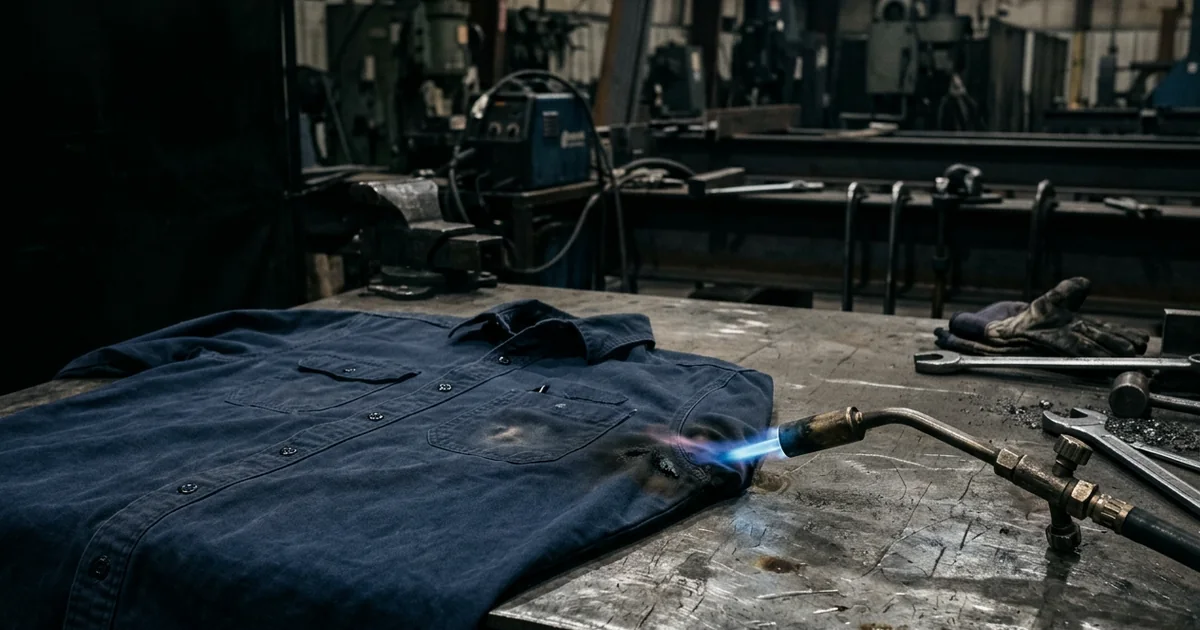
- Contamination. Oil, grease, solvents, and other flammable residues soaked into FR fabric can ignite and sustain a flame on the surface of the garment — even though the fibers themselves are still flame-resistant. A contaminated FR shirt can burn. This is why NFPA 2113 and laundering rules matter so much.
Regulators encode these limits. OSHA 1910.269 does not require an arc rating for estimated exposures of 2 cal/cm² or less, yet 1910.269(l)(8)(iv) still requires the outer layer to be flame-resistant under certain conditions even below that threshold; above the threshold, 1910.269(l)(8)(v) requires clothing with an arc rating at least equal to the estimated incident heat energy. OSHA also bans clothing that could increase injury — materials that ignite and keep burning, or that melt onto skin. Synthetic blends like acetate, nylon, polyester, and rayon are specifically prohibited as untreated outer layers in arc/flame hazard areas; cotton and wool may be acceptable only if the weight suits the hazard.
And it all starts with a hazard assessment. OSHA 1910.132 requires the employer to assess the workplace for hazards, select appropriate PPE, train workers, and provide it. That assessment — not a label that says "fireproof" — is what determines which FR or AR garment you actually need.
Frequently Asked Questions
Is any workwear truly fireproof?
No. No wearable fabric is truly fireproof because every material has a burning point. The accurate industry terms are flame-resistant (FR) and arc-rated (AR). "Fireproof" is marketing shorthand or a misunderstanding — flame-resistant clothing reduces and slows burn injury, it does not make you immune to fire.
What does flame-resistant actually mean?
Per OSHA, flame-resistant means a material resists ignition, self-extinguishes once the ignition source is removed, and does not melt or drip onto skin. It does not mean the material cannot burn at all — under enough heat or for long enough, FR fabric can still char and degrade.
Is "fire-retardant" the same as "flame-resistant"?
In everyday catalog language they're used interchangeably, but technically "fire-retardant" refers to the chemical treatment or additive that creates resistance, while "flame-resistant" describes the finished fabric's behavior — resisting ignition and self-extinguishing. A treated cotton garment is made flame-resistant by a fire-retardant finish.
What's the difference between NFPA 2112 and NFPA 70E?
NFPA 2112 covers flame-resistant clothing for short-duration flash fire and is certified with a 3-second thermal manikin test. NFPA 70E (with ASTM F1506 as the textile spec) covers electric arc flash and assigns an arc rating in cal/cm². They are distinct hazards with distinct test methods, so "FR" alone doesn't tell you which one a garment is rated for.
Can flame-resistant clothing still catch fire?
Yes, in two ways. Beyond its rated time or energy limit, any FR fabric will eventually char and degrade. And if the garment is contaminated with oil, grease, or solvents, those flammable residues can ignite and burn on the surface even though the underlying fibers are still flame-resistant. This is why proper laundering and decontamination are critical.
What do CAT or HRC numbers mean?
Under NFPA 70E, PPE Categories set minimum arc ratings: CAT 1 = 4 cal/cm², CAT 2 = 8 cal/cm², CAT 3 = 25 cal/cm², and CAT 4 = 40 cal/cm². A higher category means more protection against an arc flash. The category you need comes from your workplace hazard assessment, not from the garment label alone.
Is inherent FR better than treated FR?
Neither is universally "better," and neither is fireproof. Inherent FR (like aramid or modacrylic) builds flame resistance into the fiber so it can't be washed out. Treated FR (like FR-finished 100% cotton) applies a fire-retardant finish to a flammable base fabric. Both can meet the same standards; the right choice depends on your hazard, comfort, budget, and laundering situation.
Why Trust This Guide
I'm Wes Calder, and I review flame-resistant workwear independently for FR Gear Lab — I don't manufacture or sell FR garments. Everything in this guide is grounded in the published standards themselves (NFPA 2112, NFPA 2113, NFPA 70E, ASTM F1506) and OSHA's own regulatory language, with the source documents linked inline so you can verify every claim. Where a number matters — a cal/cm² rating, a burn-percentage threshold, an OSHA exposure limit — I cite it rather than paraphrase it, because in safety gear the details are the difference between a close call and a hospital visit. This article is general education, not a substitute for your employer's hazard assessment or a qualified safety professional's specification.