
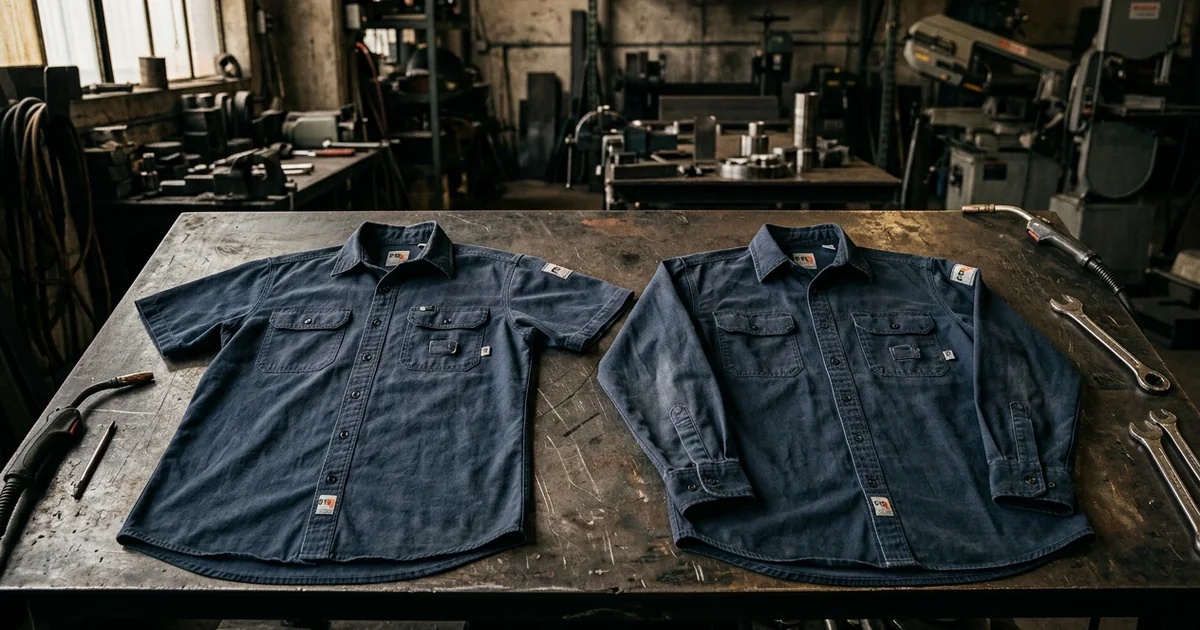
Short answer: a short-sleeve FR shirt is only as safe as the skin it actually covers. The fabric in a quality short-sleeve flame-resistant shirt can carry the same NFPA 2112 or NFPA 70E certification as a long-sleeve version — but the short-sleeve cut leaves your forearms as bare skin, and bare skin has zero protection against arc-flash or flash-fire energy. So whether a short-sleeve FR shirt is "safe" depends entirely on your hazard: it's a reasonable choice as a base layer under a long-sleeve FR garment or in documented low-exposure work, and it is not compliant as your only upper-body garment anywhere the incident energy or a flash-fire hazard demands full coverage. This guide explains exactly where that line falls and what employers are required to do about it.
Key Takeaways
- Certification is about the fabric, not the cut. An FR shirt can meet NFPA 2112 / NFPA 70E and still leave your arms exposed — see what FR clothing actually is.
- OSHA wants the whole body covered. Arc-rated protection must cover the entire body except hands, feet, face, and head — and arms are not on that exception list, so a bare-arm short-sleeve shirt fails full-body coverage above 2.0 cal/cm².
- Below 2.0 cal/cm² (arc) with no flash-fire hazard, short sleeves can be acceptable. OSHA does not require arc-rated protection for exposures of 2 cal/cm² or less — but that threshold must be documented by a hazard analysis, not assumed.
- The smartest use is as a base layer. A short-sleeve FR shirt worn under a long-sleeve FR shirt gives you torso layering plus full coverage — compare long-sleeve FR shirts for the outer layer.
- Your employer owns the call. The hazard assessment and PPE requirement are the employer's legal responsibility under the FR clothing requirements.
What a short-sleeve FR shirt protects — and what it doesn't
FR certifications grade the fabric and garment construction, not how much of your body the garment covers. Under ASTM F1506, the textile used in arc-rated electrical apparel is tested per ASTM F1959 to assign an Arc Rating (ATPV, in cal/cm²); the fabric must not melt or drip, must self-extinguish with after-flame no more than 2 seconds and a char length under 6 inches, evaluated as-received and after 25 launderings. On the flash-fire side, an NFPA 2112 garment must pass an ASTM F1930 instrumented-manikin test — a 3-second exposure at 84 kW/m² heat flux with predicted second- plus third-degree body burn of less than 50% (hands and feet excluded), with the fabric tested after 100 industrial launder/dry cycles.
Notice what every one of those tests measures: the performance of the cloth that is actually on your body. None of them says anything about a forearm with no cloth on it. That's the whole tension here — a short-sleeve FR shirt can be a perfectly certified garment and still expose two of your most-injured limbs. The fabric over your torso is doing its job; the skin below your elbow is on its own.
Why exposed forearms are the real hazard
Bare skin has no arc rating, no flash-fire rating, and no attenuation of any kind. The standards make this brutally concrete. The arc-flash boundary in NFPA 70E is defined as the distance at which incident energy reaches 1.2 cal/cm² — the widely cited threshold for the onset of a second-degree (curable) burn on bare skin. So while OSHA's PPE trigger is 2.0 cal/cm², an exposed forearm starts burning at a much lower number, because it has nothing in front of it.
The contrast is stark when you look at OSHA's own note in 29 CFR 1910.269 Appendix E: even untreated cotton clothing will reduce a 2-cal/cm² exposure below the 1.2-to-1.5 cal/cm² level needed to cause a burn. In other words, almost any covered sleeve buys you margin — and a bare short-sleeve arm gives that margin away, taking the full incident energy with no layer to slow it down.
This is also why NFPA's use standards are so insistent on coverage. NFPA 2113 — the standard for selecting, using, and maintaining flash-fire FR garments — states that FR garments are only worn properly when sleeves are rolled down with cuffs closed, front closures fully engaged, and the shirttail tucked in. The entire premise is full skin coverage; any exposed skin, including a short-sleeve cut, defeats the protection intent. Most severe burns happen exactly where non-FR or exposed areas ignite. Rolling up the sleeves on a long-sleeve FR shirt creates the same gap a short-sleeve shirt builds in by design.
What OSHA actually requires for coverage
OSHA's rule for electrical work is specific and worth quoting in plain terms. Under 29 CFR 1910.269(l)(8)(v), employers must ensure employees wear protective clothing with an arc rating greater than or equal to the estimated incident heat energy whenever that estimate exceeds 2.0 cal/cm². And Appendix E states plainly that "paragraph (l)(8)(v) of § 1910.269 does not require arc-rated protection for exposures of 2 cal/cm² or less."
But there's a second, equally important rule about how much of you must be covered. OSHA requires that arc-rated protection "cover the employee's entire body, with limited exceptions for the employee's hands, feet, face, and head." Read that exception list again: hands, feet, face, head. Arms are not on it. So a short-sleeve FR shirt worn as the sole upper-body garment does not satisfy full-body coverage anywhere the incident energy exceeds 2.0 cal/cm² — the arms have to be covered, whether by a long-sleeve arc-rated shirt or by separate arc-rated sleeves.
OSHA also prohibits meltable, flammable, or non-FR clothing in arc and flash hazard zones, because such fabrics can ignite or melt onto skin and worsen burns. Practically, that means an untucked shirt, rolled-up sleeves, or an exposed short-sleeve forearm undermines the protective system even when your outer layer is arc-rated. The PPE only works as a complete, closed envelope.
CAT levels assume your arms are covered
If your workplace assigns arc-flash PPE by category, every category already bakes in arm coverage. NFPA 70E Table 130.5(G) defines four arc-flash PPE Categories by minimum garment arc rating, and all of them assume arc-rated clothing covering the arms and torso. None of these category clothing systems is satisfied by a bare-arm short-sleeve configuration.
| PPE Category | Minimum arc rating | Bare-arm short sleeve compliant? |
|---|---|---|
| CAT 1 | 4 cal/cm² | No — arms must be covered |
| CAT 2 | 8 cal/cm² | No — arms must be covered |
| CAT 3 | 25 cal/cm² | No — arms must be covered |
| CAT 4 | 40 cal/cm² | No — arms must be covered |
This is the trap to avoid: a short-sleeve shirt can be labeled "CAT 2" or "8+ cal" because its fabric meets the CAT 2 arc rating, yet wearing it alone still fails the CAT 2 clothing system, which expects covered arms. A CAT rating on the tag is a fabric claim, not a coverage guarantee.
When a short-sleeve FR shirt is actually acceptable
Short-sleeve FR shirts exist for real reasons, and there are two configurations where they make sense. First, as an arc-rated base layer beneath a long-sleeve FR garment. Layering FR over FR can raise your effective protection, and because the long-sleeve outer layer covers your arms, the short-sleeve under-layer never leaves skin exposed. This is the cleanest, most defensible way to wear one.
Second, in documented low-exposure work where a hazard analysis shows the incident energy is at or below 2.0 cal/cm² for arc and there is no flash-fire hazard present. Per OSHA Appendix E, arc-rated protection isn't required at or below that threshold — but the operative word is documented. That 2.0 cal/cm² figure has to come from your employer's incident-energy analysis, not a guess.
Outside those two cases — routine arc-flash work above 2.0 cal/cm², or any flash-fire-exposed work covered by NFPA 2112/2113 — a short-sleeve shirt worn alone is not compliant, because it leaves your arms unprotected. For those jobs, reach for a long-sleeve arc-rated or flash-fire-rated shirt. Our best FR shirts roundup and the long-sleeve picks cover the garments that do close that gap.
Frequently Asked Questions
Are short-sleeve FR shirts OSHA-compliant?
Only in specific situations. OSHA requires arc-rated clothing to cover the entire body except hands, feet, face, and head wherever incident energy exceeds 2.0 cal/cm². Because arms are not on that exception list, a short-sleeve FR shirt worn alone is not compliant above 2.0 cal/cm². At or below 2.0 cal/cm² with no flash-fire hazard, OSHA Appendix E does not require arc-rated protection, so a short-sleeve FR shirt can be acceptable if your employer's hazard analysis documents that exposure level.
If they're risky, why do stores sell short-sleeve FR shirts?
Because they have legitimate uses. A short-sleeve FR shirt is well suited as an arc-rated base layer under a long-sleeve FR garment, and for low-hazard or indoor work where a documented incident-energy analysis comes in at or below 2.0 cal/cm² with no flash-fire risk. The garment fabric can carry NFPA 2112 or NFPA 70E certification; the limitation is the cut, not the cloth. Problems arise only when the shirt is worn alone in a hazard that demands full arm coverage.
Can I wear a short-sleeve FR shirt under a long-sleeve FR shirt?
Yes — this is the safest way to use one. The long-sleeve outer FR layer covers your arms, so the short-sleeve under-layer never exposes skin, and FR-over-FR layering can improve your effective protection. Both layers should be flame-resistant; a non-FR or meltable under-layer is prohibited in arc and flash hazard zones because it can ignite or melt onto skin.
Does an NFPA 2112 label make a short-sleeve FR shirt safe for flash fire?
No. NFPA 2112 certifies the fabric and garment construction by passing an ASTM F1930 manikin test — a 3-second, 84 kW/m² exposure with predicted second- plus third-degree burn under 50%. It does not make a short-sleeve cut adequate for a given exposure. NFPA 2113 requires sleeves rolled down, cuffs closed, and shirttail tucked, because exposed skin defeats the protection. A short-sleeve cut builds that exposed skin in by design, so it should not be the sole garment in flash-fire work.
Why does OSHA use 2.0 cal/cm² but burns happen at 1.2?
They measure two different things. The 1.2 cal/cm² figure is the incident energy at which bare skin begins to suffer a second-degree burn, and it defines the arc-flash boundary in NFPA 70E. The 2.0 cal/cm² figure is OSHA's trigger for requiring arc-rated PPE. The gap exists partly because almost any covered clothing layer attenuates energy — OSHA notes even untreated cotton reduces a 2-cal exposure below the burn threshold. A bare forearm has no such layer, which is exactly why exposed skin is judged against the lower 1.2 number.
A short-sleeve shirt is marked CAT 2 / 8+ cal — am I covered?
Not by itself. A CAT 2 mark means the fabric meets the 8 cal/cm² minimum arc rating, but NFPA 70E's CAT 2 clothing system assumes arc-rated clothing covering both the arms and torso. Wearing a CAT 2 short-sleeve shirt alone leaves your arms bare and does not satisfy the CAT 2 system. You would need a long-sleeve arc-rated shirt, or arc-rated sleeves, to complete arm coverage.
Can I just roll up the sleeves on a long-sleeve FR shirt instead?
No. Rolling up FR sleeves creates the same exposed-skin gap as a short-sleeve cut. NFPA 2113 specifies that FR garments are worn properly only with sleeves rolled down and cuffs closed. Rolled-up sleeves expose the forearm to full incident energy and undermine the protective system even when the shirt itself is arc-rated.
Why Trust This Guide
I'm Wes Calder, and I run FR Gear Lab as an independent flame-resistant-workwear review site — I don't take manufacturer placement for a ranking. For a YMYL safety topic like this one, I tie every standards claim to the primary source: OSHA 29 CFR 1910.269 and its Appendix E, NFPA 70E, NFPA 2112, NFPA 2113, and ASTM F1506. Where a number isn't published — a specific ATPV value, an oz weight, or whether a fabric is inherent or treated — I say "not stated" rather than guess, because borrowing one garment's cal/cm² for another is exactly how people end up under-protected. The bottom line I'd give any crew: certification is about the cloth, coverage is about the cut, and your employer's hazard analysis decides which one you're allowed to lean on.