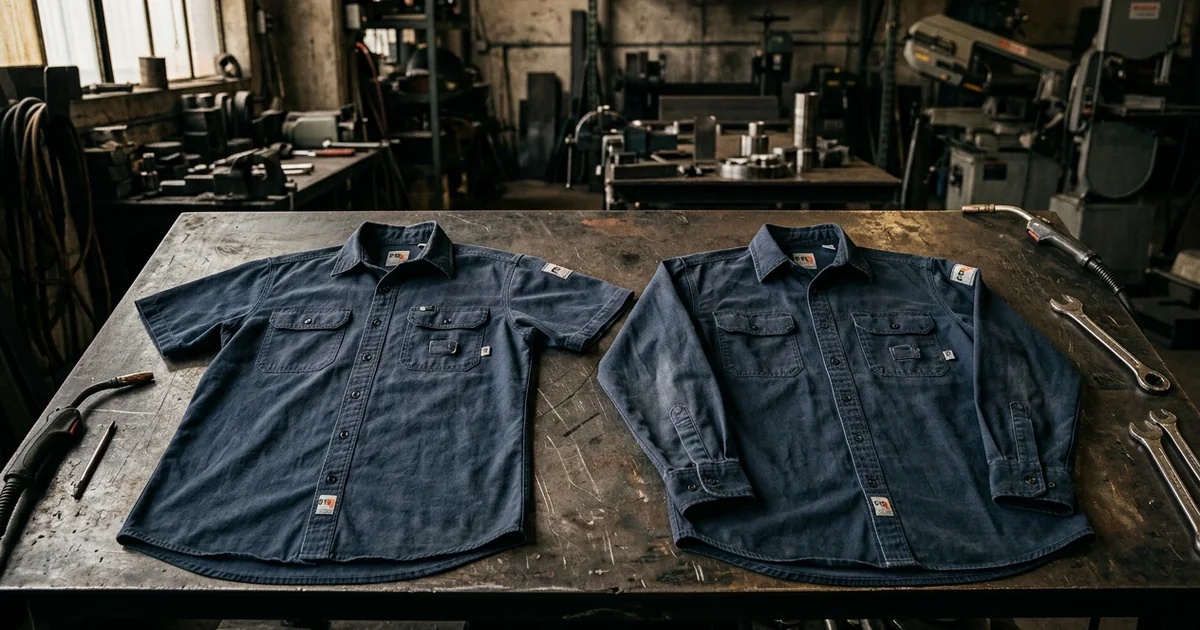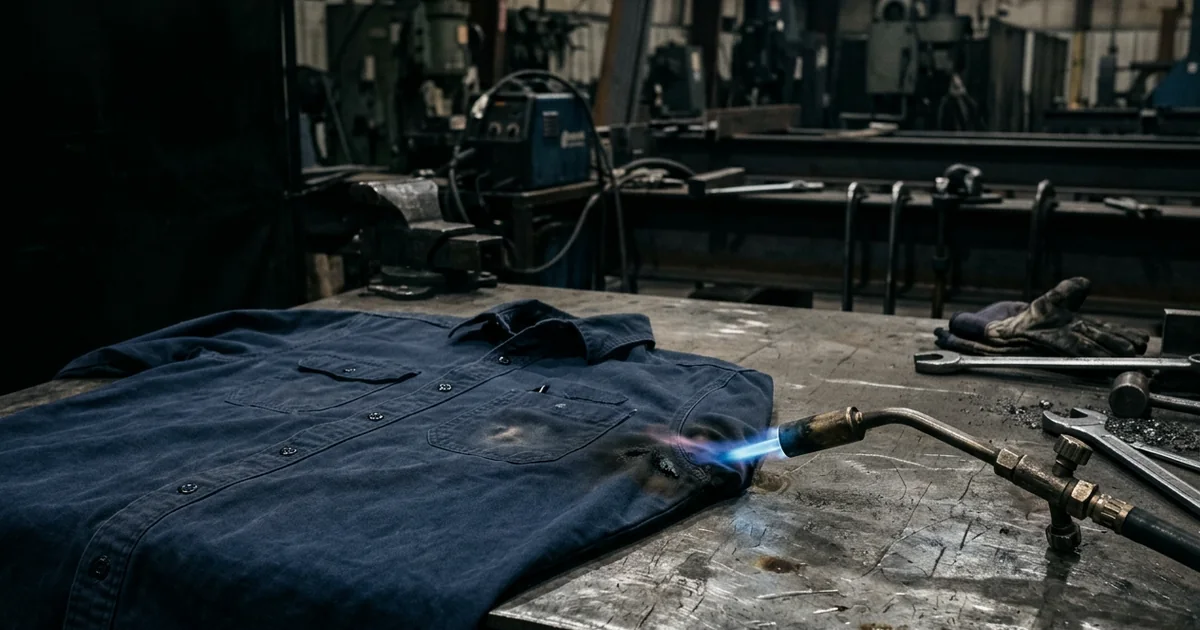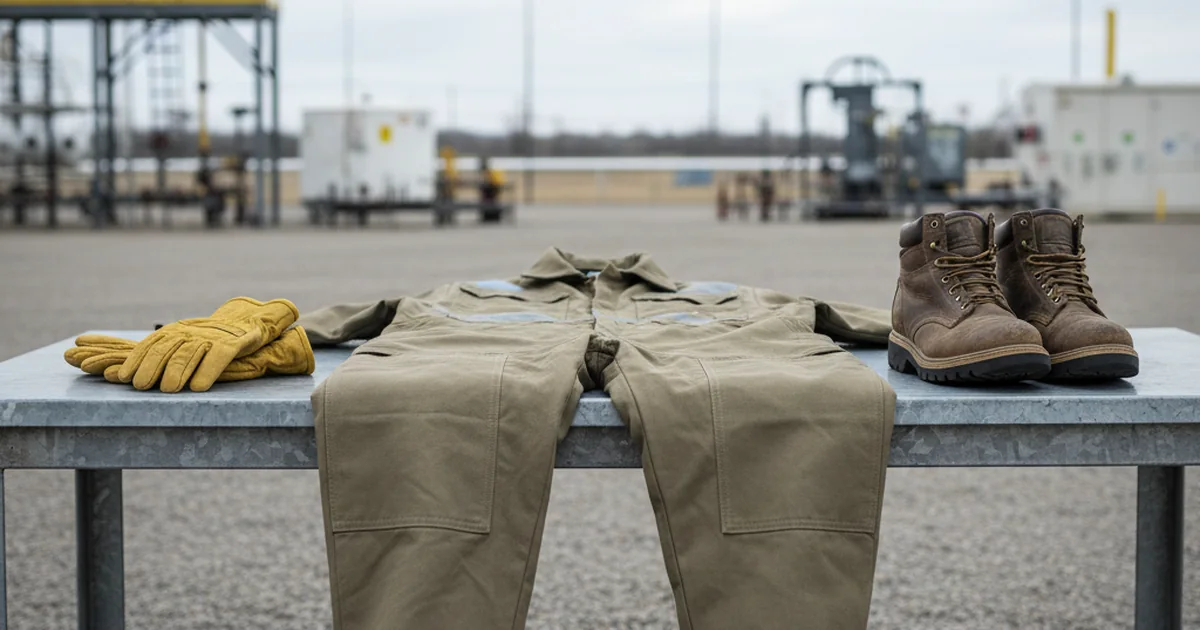

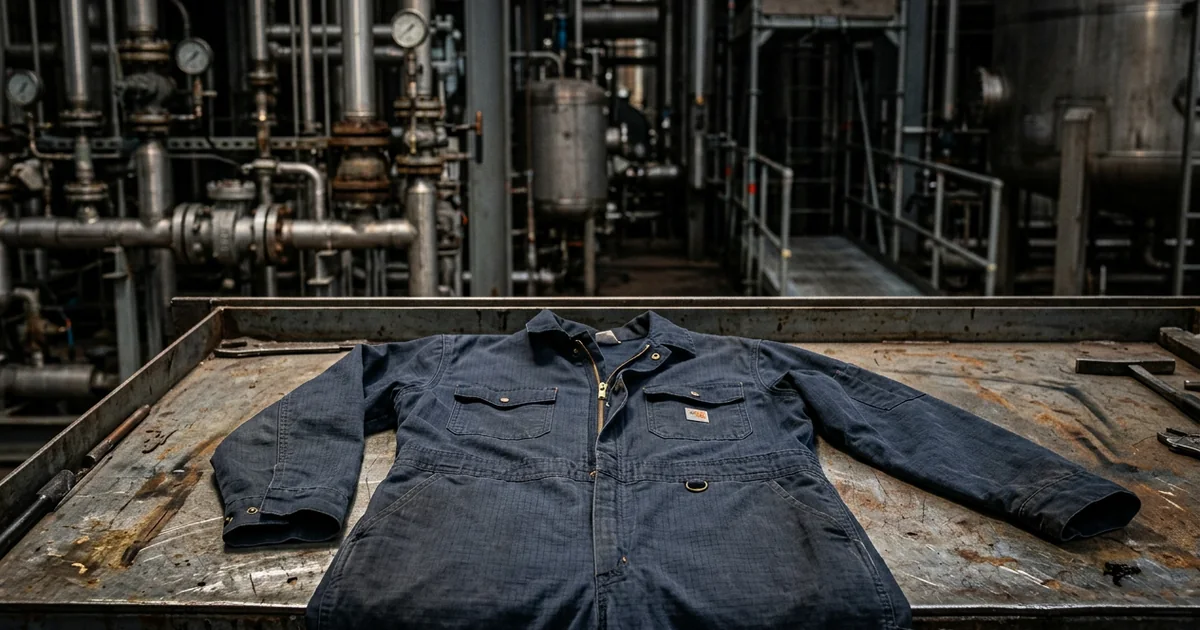
"Anti-static FR clothing" is workwear that does two separate jobs at once: it resists flame or arc (the FR part) and it bleeds off static charge before that charge can spark (the anti-static part). The thing most buyers get wrong is assuming one label covers both. It doesn't. Static-dissipative FR clothing is flame-resistant apparel built with conductive fibers — usually carbon or metal threads woven into the fabric — so electrostatic charge drains away safely instead of building up and discharging as a spark. A garment can be fully NFPA 2112 flash-fire certified and still have zero anti-static rating, because flash-fire protection and static control are governed by completely different standards and tests. If you work around flammable vapors — fuel handling, solvents, petrochemicals — you generally need a garment that carries both a flame standard and a separate anti-static standard like EN 1149-5.
Key Takeaways
- Anti-static and FR are two different properties. FR resists ignition and self-extinguishes; anti-static (static-dissipative) drains charge so it can't spark. A garment needs both certifications to do both jobs — see what FR clothing actually is.
- NFPA 2112 does not test for anti-static. The flagship U.S. flash-fire standard has no static-dissipative requirement. Anti-static performance is governed separately (EN 1149-5 in Europe; ESD/bonding controls under OSHA in the U.S.).
- Static really does ignite vapors. A person can build up 10,000–15,000 volts walking across dry flooring, and a human-body discharge can release enough energy to ignite most hydrocarbon vapors.
- Anti-static clothing is a complement, not a replacement, for grounding. Bonding and grounding equipment is the primary spark control; static-dissipative garments limit charge on the worker — relevant for FR clothing in oil and gas.
- How the fabric is made matters. Conductive yarns are woven on a grid; whether the base is inherent or treated FR is a separate question from whether it's anti-static.
What "anti-static FR" actually means
Two independent properties are bundled into one garment:
Flame resistance (FR) means the fabric resists ignition, doesn't melt onto skin, and self-extinguishes once the flame source is removed. In the U.S. this is certified against standards like NFPA 2112 for flash fire or ASTM F1506 for electric-arc work.
Anti-static (static-dissipative) means the fabric carries a network of conductive fibers — carbon or metal threads woven through the cloth — so any static charge that accumulates on the wearer drains away gradually instead of jumping as a spark. Per the European framework standard EN 1149-5, a common design rule is conductive yarns spaced no more than about 10 mm apart, with all metal hardware (zippers, snaps) kept covered so it can't become an isolated spark point.
The critical takeaway: these properties are independent. An ordinary cotton T-shirt is anti-static-ish (cotton holds little charge) but burns readily. A modern synthetic FR shell can be excellent at flash-fire protection yet build up dangerous static in dry air. To get both, a garment needs a flame/arc standard and a separate anti-static standard layered together. EN 1149-5 explicitly notes that anti-static performance is independent of FR or arc rating.
Why static is an ignition hazard around flammable atmospheres
Static electricity is a recognized ignition source. According to OSHA's analysis of static hazards, a person can accumulate roughly 10,000–15,000 volts simply walking across insulating flooring in dry conditions, and a human-body electrostatic discharge can release on the order of 10–30 millijoules of energy. That matters because most hydrocarbon vapors and solvents have minimum ignition energies below about 30 mJ — meaning a single static spark off your body or clothing can be more than enough to ignite the air around you.
This is the whole reason fuel-handling and petrochemical operations pair static-dissipative garments with bonding and grounding. Under OSHA 29 CFR 1910.106, Class I flammable liquids (flash point below 100°F / 37.8°C) must be bonded and grounded during transfer specifically to prevent static-spark ignition. Anti-static clothing is a complementary control here — it limits charge build-up on the worker's body and clothing, but it does not replace bonding/grounding of equipment and containers.
So the picture in a flammable-vapor area is layered: ground the equipment, bond the containers, and dress the worker in static-dissipative FR so the human in the loop isn't the spark.
How anti-static relates to FR and arc standards
Here's where buyers get tangled, because three different standards each cover one slice of the problem and none of them covers anti-static:
Flash fire — NFPA 2112. The 2023 edition of NFPA 2112 sets minimum design, performance, and certification requirements for FR clothing where flash fire is a risk; its thermal protective performance requirement is a spaced HTP of at least 6.0 cal/cm². Crucially, NFPA 2112 contains no anti-static test requirement — that property lives entirely outside the standard. Its companion NFPA 2113 governs selection, care, and maintenance of those garments and explicitly does not apply to electrical/arc, wildland, or hazmat exposures.
Electric arc — ASTM F1506 + NFPA 70E. ASTM F1506 is the material spec that produces an arc rating (ATPV or EBT, in cal/cm²) for clothing worn by electrical workers. The ATPV is the incident energy at which there's a 50% probability of a second-degree burn. NFPA 70E then maps those ratings into arc-flash PPE categories:
| NFPA 70E PPE Category | Minimum arc rating |
|---|---|
| Category 1 | 4 cal/cm² |
| Category 2 | 8 cal/cm² |
| Category 3 | 25 cal/cm² |
| Category 4 | 40 cal/cm² |
The arc-flash boundary is the distance where incident energy drops to 1.2 cal/cm² (the bare-skin second-degree-burn threshold). NFPA 70E covers arc and shock — not flash fire and not anti-static.
Anti-static — EN 1149-5 (Europe) / ESD controls (U.S.). EN 1149-5 is the framework that sets pass/fail criteria, referencing test methods EN 1149-1 (surface resistivity) and EN 1149-3 (charge decay). There is no single U.S. garment standard that bundles FR/arc protection with anti-static certification — in the U.S., static dissipation is handled through workplace ESD controls and bonding/grounding under standards like OSHA 1910.269 and 1910.106 rather than a clothing label. So for oil & gas or fuel handling, a garment is typically specified to meet NFPA 2112 (flash fire) and/or NFPA 70E–ASTM F1506 (arc) and EN 1149-5 (anti-static) together.
What OSHA actually requires of the clothing
OSHA doesn't issue an "anti-static FR" certificate, but two rules drive the choice. 29 CFR 1910.132 requires employers to assess the workplace for hazards (with a written hazard-assessment certification), then select and provide PPE that protects each affected employee and fits properly — this is the general-duty basis for choosing FR and/or anti-static clothing once a flash-fire, arc, or flammable-atmosphere hazard is identified.
For electrical/arc work, 29 CFR 1910.269(l)(8) goes further: employers must ensure employees exposed to flame or electric-arc hazards do not wear clothing that could melt onto skin or ignite and keep burning (untreated acetate, nylon, polyester, rayon, and polypropylene are prohibited), and employees exposed to electric arcs must wear clothing with an arc rating at least equal to the estimated incident heat energy whenever that estimate exceeds 2.0 cal/cm². The static-dissipative piece, again, is layered on top through the hazard assessment — not spelled out as a garment rating in these rules.
Frequently Asked Questions
Does FR clothing automatically mean it's anti-static?
No. Flame resistance and anti-static (static-dissipative) are two separate properties governed by different standards. A garment can be fully NFPA 2112 flash-fire certified and have no anti-static rating at all. To get both, the garment must carry a flame/arc standard (NFPA 2112, NFPA 70E/ASTM F1506, or EN ISO 11612) AND a separate anti-static standard like EN 1149-5.
Does NFPA 2112 cover anti-static performance?
No. NFPA 2112 (2023) sets flash-fire thermal protection requirements — including a spaced HTP of at least 6.0 cal/cm² — but it contains no anti-static or static-dissipative test requirement. Anti-static is a separate property, addressed in Europe by EN 1149-5 and in the U.S. through workplace ESD and bonding/grounding controls.
How does static-dissipative fabric actually work?
Conductive carbon or metal fibers are woven through the fabric in a grid so that static charge drains away safely instead of building up and discharging as a spark. A common EN 1149-based design rule is conductive yarns spaced no more than about 10 mm apart, with all metal hardware like zippers and snaps kept covered.
Can static electricity really ignite flammable vapors?
Yes. A person can accumulate roughly 10,000–15,000 volts walking across insulating flooring in dry conditions, and a human-body discharge can release about 10–30 millijoules — enough to ignite most hydrocarbon vapors and solvents, whose minimum ignition energies fall below about 30 mJ. That's why fuel and petrochemical work pairs static-dissipative clothing with bonding and grounding.
Does anti-static clothing replace bonding and grounding?
No. Bonding and grounding of equipment and containers is the primary spark control and is required for transferring Class I flammable liquids under OSHA 1910.106. Static-dissipative clothing is a complementary control that limits charge build-up on the worker's body and clothing — it does not replace grounding.
Is there a single U.S. standard that combines FR and anti-static?
No. NFPA 2112 covers flash-fire thermal protection, ASTM F1506 plus NFPA 70E cover electric arc, and static dissipation is governed separately — by EN 1149-5 in Europe, and in the U.S. through ESD controls and bonding/grounding under OSHA rules rather than a clothing label. A garment for flammable-atmosphere work is typically specified to meet a flame/arc standard and EN 1149-5 together.
Who actually needs anti-static FR clothing?
Workers in flammable atmospheres where a static spark could ignite vapors — fuel handling, refueling, solvent and chemical processing, and petrochemical operations. The trigger is OSHA's hazard assessment under 1910.132: if a flammable-atmosphere or flash-fire/arc hazard is identified, the employer selects clothing that addresses it, which can mean both FR and anti-static together.
Why Trust This Guide
I'm Wes Calder, and I run FR Gear Lab as an independent flame-resistant-workwear review site. I don't sell FR garments or certify them. For a YMYL safety topic like this, I keep claims tied to the actual standards documents — NFPA 2112/2113, ASTM F1506, NFPA 70E, EN 1149-5, and the relevant OSHA rules — and link the authoritative source for every standards claim so you can verify it yourself. Where a property isn't covered by a standard (as anti-static isn't covered by NFPA 2112), I say so plainly rather than implying a single label does everything. When in doubt about a specific job, follow your employer's documented hazard assessment and the garment's own certification labels.