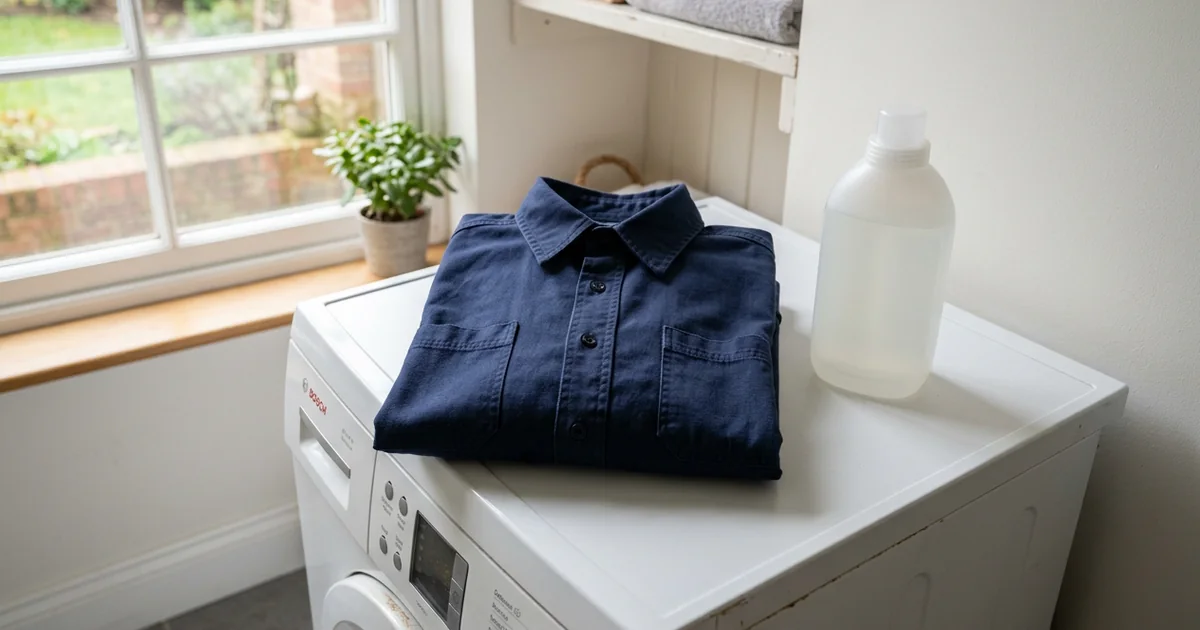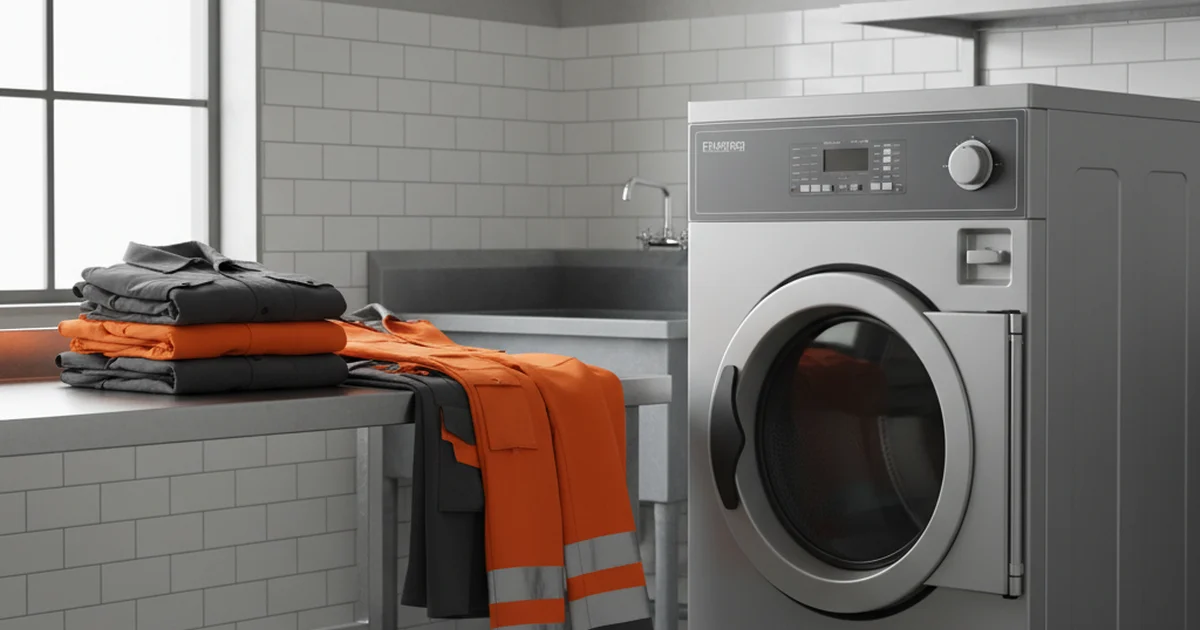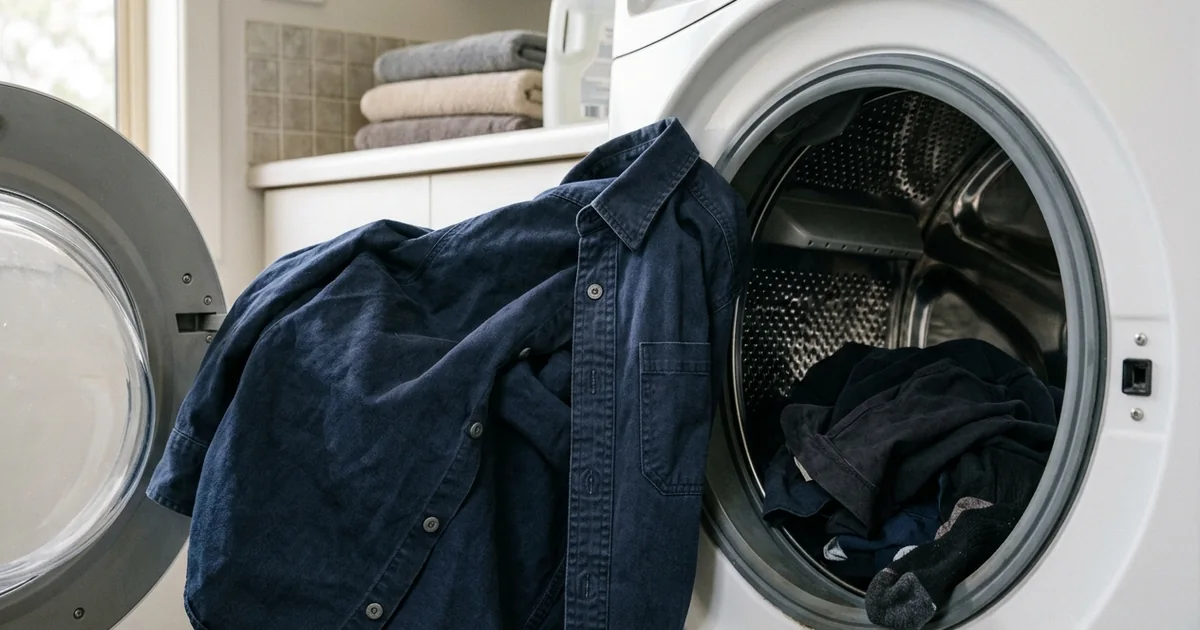

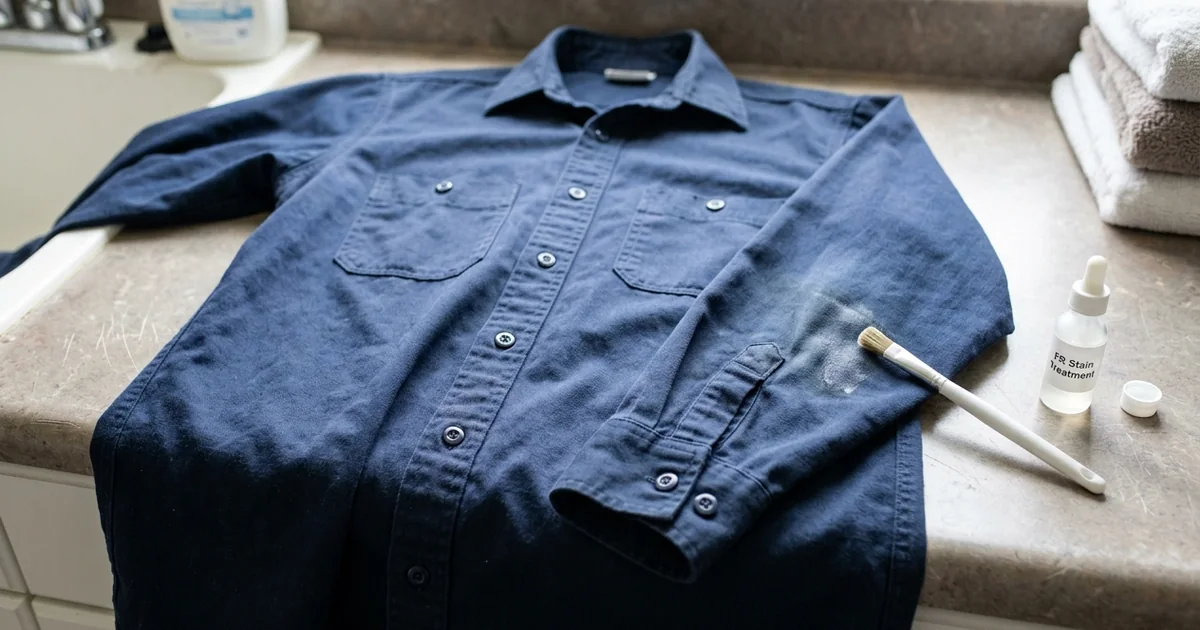
Grease and oil on flame-resistant clothing isn't a laundry-day cosmetic problem — it's a fire hazard. To get it out safely: pre-treat the oily spot, wash warm (not cold) with ordinary home liquid detergent, and never use bleach, fabric softener, or starch. If the contaminant won't flush out after laundering, the garment has to be retired — not worn. What is flame-resistant (FR) clothing? Fabric that resists ignition, self-extinguishes, and won't melt onto skin — it is not "fireproof," and it can't protect you if it's soaked in something that burns.
Here's the part most care guides skip: when your FR shirt catches fire, the fabric self-extinguishes — but a petroleum-based soil deposited on it doesn't. Oil, grease, and fuel can ignite during an arc flash or flash fire and keep burning against your skin even though the FR garment itself has gone out. The contaminant, not the fabric, is what burns you. That's why this is a safety task, not a stain task.
Key Takeaways
- Contamination is fuel, not a stain: per Tyndale's technical guidance, oil/grease/fuel on FR "can ignite during an arc flash or flash fire and cause injury even though the FR garment will self-extinguish."
- Surface stain ≠ saturation: Benchmark FR draws the line cleanly — a cosmetic stain "has no measurable impact and is considered safe," but flammable contamination "must be washed off the garments."
- Warm water, not cold: cold water may leave oils behind that can fuel combustion, so makers call for warm washing — Carhartt caps most FR fabrics at 160°F (70°C), lined FR at 140°F (60°C); always defer to your care label.
- Never use: chlorine or hydrogen-peroxide bleach, fabric softener, dryer sheets, starch, or lye/tallow soap — they degrade FR or leave a flammable coating.
- Flush it or retire it: if a flammable substance is permanently embedded and can't be laundered out, the garment must be removed from service. This is the single most safety-critical call in FR care.
Why grease and oil on FR clothing is a real hazard, not a cosmetic one
Flame-resistant fabric works by self-extinguishing once the ignition source is gone — that's the whole point of what FR clothing is. But that protection assumes the surface of the garment is the FR fabric. Coat it in a petroleum-based soil and you've added a fuel layer the fabric can't control.
The authoritative standard for this is NFPA 2113 — the Standard on Selection, Care, Use, and Maintenance of flame-resistant garments. Its stated purpose includes reducing the risks "associated with incorrectly maintained, contaminated, or damaged flame-resistant garments." In plain terms: residual soils, especially petroleum-based ones, can mask the flame resistance of the fabric and become fuel for an ignition source. (NFPA 2113's exact internal text is paywalled; this contamination language is described in authoritative summaries of the standard and is corroborated across the manufacturer sources below — always defer to the current edition and your garment's care label.)
The manufacturers say the same thing more bluntly. Tyndale: oil, gas, and grease stains "can ignite during an arc flash or flash fire and cause injury even though the FR garment will self-extinguish." Bulwark: greases and oily soils "can burn independently and overwhelm the FR properties of the fabric." When your gear self-extinguishes but the fuel on it doesn't, the garment stops protecting you.
Surface stain vs. saturation: the distinction almost no guide makes
This is where the field gets it wrong, and it matters because a worker staring at a faded oil shadow deserves to know whether it means "keep wearing" or "retire now." There are two different situations, and only one is dangerous.
A surface stain — discoloration only, with no flammable material left in the fabric — is cosmetic. Benchmark FR states it plainly: "Stains have no measurable impact and are considered safe." A permanent dye shadow from something that has been fully washed out is ugly, not unsafe.
Saturation or contamination — where flammable material is actually embedded in the fibers — is the hazard. Benchmark again: "All materials influencing flammability must be washed off the garments." The test isn't "does it look clean," it's "is there still something in this fabric that will burn." A garment can look stained but be safe, or look nearly clean but still carry fuel deep in the weave. The mechanism, not the appearance, is what you're managing.
How to safely get grease, oil, and stains out of FR clothing
The correct method is consistent across Tyndale, Bulwark, Carhartt, and Benchmark. It's ordinary home laundering done deliberately — not a special chemical, not cold-water gentleness.
- Pre-treat the oily spot. Spot-treat the mark before washing with liquid detergent worked into it, or a pre-treat product like Shout or Spray 'N Wash. Tyndale: "try spot-treating stains with detergent prior to washing." This is what breaks the oil loose so it can actually rinse out.
- Wash warm, with home detergent. Machine wash in warm water using ordinary home liquid laundry detergent — makers name Tide and All specifically. For heavily soiled garments, wash at the hottest temperature your care label allows.
- Don't overload the washer. Bulwark is explicit: don't cram the machine, because soils only rinse away if garments have room to move. Hard water also precipitates mineral salts that can serve as fuel, so a softening agent (like Calgon) or a water softener improves contaminant removal.
- Escalate if it doesn't come out. Run extra cycles. If home laundering still doesn't remove all the flammable soil, step up to commercial/industrial laundering or dry cleaning — Tyndale and Bulwark both recommend this for severely soiled garments.
- Confirm it's clean, then dry low. Tyndale: "Make sure that all flammable substances are removed before the garment is worn again." Tumble dry on low and remove promptly.
None of this is exotic. The discipline is in the details — warm not cold, pre-treat the oil, don't overload, and actually verify the fuel is gone before the garment goes back on.
Why warm water — and never cold-only
Temperature is the one spec workers get wrong most, usually by defaulting to cold to "protect" the garment. The problem: cold water may not lift oils. Carhartt's own guidance notes that cold water may not remove oils, dirt, and contaminants that can fuel combustion, which is exactly why warm-water washing is recommended. Leave the oil in and you've defeated the whole wash.
Warm doesn't mean scalding, and the ceiling is set by the fabric, not by you. Manufacturers publish limits — here's what the fetched care pages state:
| Source | Wash temp | Dry | Detergent named |
|---|---|---|---|
| Carhartt (unlined / denim / twill / chambray FR) | Warm, not to exceed 160°F (70°C) | Tumble dry low, remove promptly | Standard detergent |
| Carhartt (lined FR) | Warm, not to exceed 140°F (60°C) | Tumble dry low, remove promptly | Standard detergent |
| Benchmark FR | Warm, max 140°F (60°C) | Tumble dry low, max 160°F (71°C) | Tide or All |
| Tyndale | Warm to minimize shrinkage; hottest label setting for heavily soiled | — | Liquid Tide / Tide HE |
| Your care label | Governs everything above | Follow the tag | Follow the tag |
The takeaway: warm enough to flush the oil, capped by the fabric's own limit. When Carhartt and Benchmark disagree on the top number, it's because they're rating different fabrics — which is precisely why the care label wins over any general rule of thumb.
What to never put on FR clothing
The banned list isn't manufacturer fussiness — each item either degrades the FR or leaves a flammable coating. Consistent across all four makers:
- Chlorine bleach. Tyndale: "There is data to suggest that bleach can degrade the FR characteristics of the fabric." Both liquid chlorine bleach and detergents containing it are out.
- Hydrogen-peroxide (oxidative) bleach. Excluded by Carhartt and Benchmark for the same reason.
- Fabric softener and dryer sheets. They coat the fibers with chemicals that mask FR performance and can make the garment more flammable.
- Starch. The subtle one. Starch doesn't chemically erode FR — but as Tyndale explains, "it is a flammable substance… Any flammable substance deposited on top of the AR/FR fabric can contribute to body burn." Sitting on top of the fabric, it burns. Same logic that condemns oil.
- Lye/tallow soap (and open steam). Benchmark excludes lye-based soap and open steam. And by the same starch-and-oil logic, anything that leaves a flammable residue on the fabric has no place on an FR garment — if it can burn, it can defeat the protection.
One nuance worth carrying to your next purchase: this care regimen doesn't wash the flame resistance out of a properly made garment. Benchmark notes its inherent-FR garments "will remain flame resistant for the life of the garment provided they are cared for properly." If you want the durability trade-offs spelled out, see inherent vs. treated FR — but for cleaning grease, the method above is the same either way.
When to retire an FR garment instead of cleaning it
This is the honest safety call the SERP mostly buries, and it's the most important sentence in this guide: if a flammable substance is permanently embedded and can't be removed by laundering, the garment must be retired from service — not worn.
Tyndale states the retirement trigger directly: retire when "the garment is stained with a flammable substance that cannot be removed through laundering." NFPA 2113 guidance points the same way — a garment that becomes heavily soiled or emits an odor of petroleum-based substances should be removed from service for cleaning or replacement, and if the contaminant can't be removed, the garment should be retired.
So the decision tree is short. Flush it if you can. Escalate to commercial laundering or dry cleaning if home washing isn't enough. And if the fuel is permanently in the fabric — if it still smells of petroleum after everything, or the oil saturation simply won't come out — retire it. No FR rating survives being soaked in something that burns, and no garment is worth a body burn. If you're replacing a retired piece, our guide to FR clothing for oil and gas covers what holds up in high-contamination work.
Frequently Asked Questions
Is an oil stain on my FR clothing unsafe to wear?
It depends on whether it's a surface stain or actual contamination. Per Benchmark FR, a cosmetic stain — discoloration only, with the flammable material washed out — "has no measurable impact and is considered safe." But if flammable material is still embedded in the fabric, it can ignite in an arc flash or flash fire and burn against your skin. Wash it out; if it won't flush, retire the garment.
Can I wash FR clothing in cold water?
Cold-only isn't recommended for greasy or oily FR garments. Carhartt's guidance notes cold water may not remove oils, dirt, and contaminants that can fuel combustion, which is why makers call for warm washing. Wash warm — up to your care label's ceiling (Carhartt caps most FR fabrics at 160°F, lined FR at 140°F; Benchmark at 140°F) — so the oil actually flushes out instead of staying locked in the fibers.
Can I use bleach or a stain remover on FR clothing?
No bleach — Tyndale states there is data to suggest bleach can degrade the FR characteristics of the fabric, and that applies to both chlorine and hydrogen-peroxide bleach. For stains, pre-treat with ordinary liquid detergent or a pre-treat product like Shout or Spray 'N Wash before washing warm. Skip fabric softener, dryer sheets, and starch too — they leave a flammable coating on the fabric.
Should I wash FR clothing at home or use a commercial laundry?
Home laundering works for most soils — warm water, ordinary detergent like Tide or All, don't overload the washer. But if home washing doesn't remove all the flammable soil, both Tyndale and Bulwark recommend escalating to commercial or industrial laundering, or dry cleaning, for severely soiled garments. The rule is simple: every flammable substance must be gone before the garment is worn again.
When should I retire an FR garment instead of cleaning it?
Retire it when a flammable substance is permanently embedded and can't be removed by laundering — Tyndale names this as a retirement trigger, and NFPA 2113 guidance says a garment that stays heavily soiled or smells of petroleum should be removed from service. If the oil saturation won't flush out after home washing, extra cycles, and commercial laundering, the garment is no longer safe. Replace it.
Does washing FR clothing wear out its flame resistance?
Not when it's cared for correctly. Benchmark FR states its inherent-FR garments remain flame resistant for the life of the garment provided they're cared for properly. The bigger risk to protection isn't the wash cycle — it's leaving grease and oil in the fabric, or using banned products like bleach, softener, and starch. Use warm water and home detergent, skip the forbidden additives, and the FR holds.
Why Trust This Guide
This guide is written and reviewed by Wes Calder, an independent flame-resistant-workwear reviewer. Every recommendation is built on the published standards (NFPA 2112, NFPA 70E, ASTM F1506), manufacturer spec sheets and garment tags, hands-on handling, and what tradespeople actually report — and we tell you when a number is a manufacturer claim versus an independent standard, and when a garment is FR but not arc-rated. We earn an affiliate commission if you buy through some of our links, at no extra cost to you, and we never rank by commission over safety — see our affiliate disclosure.