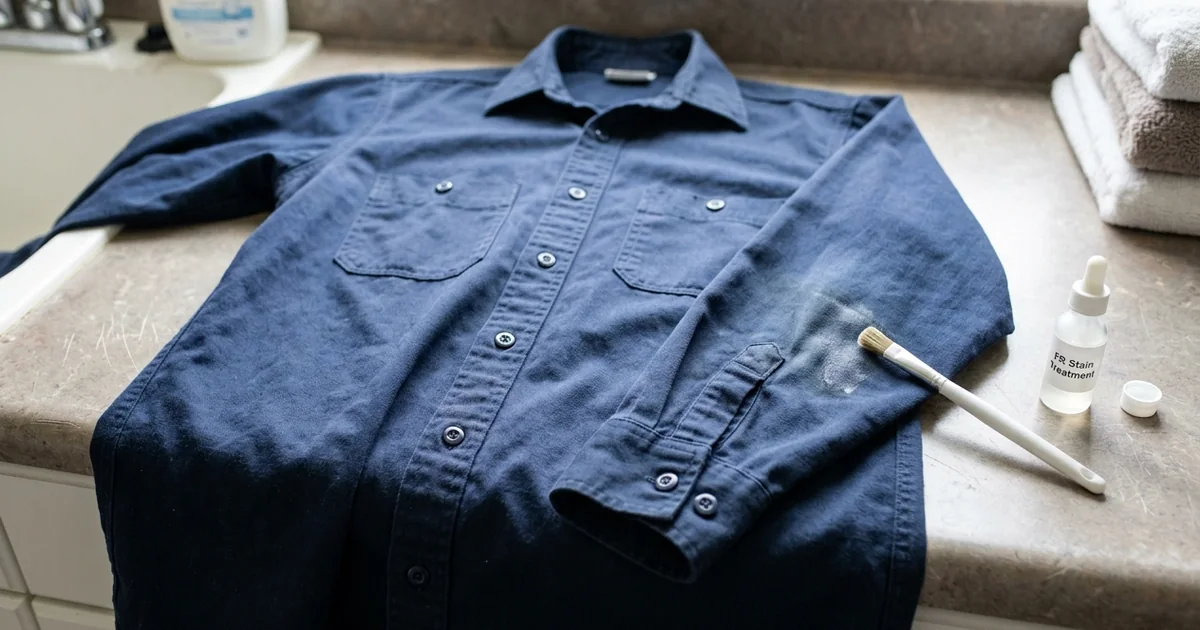

Short answer: no — you should not use fabric softener on flame-resistant (FR) clothing. Fabric softener works by depositing a thin coating on the fibers, and that coating can leave a residue on the fabric surface that has no business being on a garment whose entire job is to resist ignition and self-extinguish. If you want your FR gear to keep protecting you, keep the softener — liquid and dryer sheets alike — out of the wash. What is fabric softener? A laundry additive that coats fabric fibers to make them feel softer and reduce static — the coating is the problem for FR gear, because it's an extra layer left sitting on a garment engineered to resist flame.
Key Takeaways
- Skip it entirely: fabric softener leaves a residue on the fabric, and residues don't belong on gear built to resist ignition and self-extinguish.
- Dryer sheets count too: they're the dryer version of the same coating chemistry — leave them out as well.
- The care tag is the authority: your garment's own manufacturer care instructions govern how it's washed — follow them over any general rule of thumb.
- FR is a safety category: unlike an everyday shirt, a compromised FR garment can fail when you need it most, so the cost of a shortcut isn't a stiff collar — it's your protection.
Why not fabric softener on FR clothing?
Here's the mechanism in plain terms. Fabric softener — whether it's the liquid you pour in the rinse or the dryer sheet you toss in — works by depositing a coating onto the fibers so the fabric feels softer and holds less static. On a cotton tee, that's a feature. On an FR garment, that coating is an unwanted layer of something on the surface of a fabric that is supposed to do one job: resist ignition and self-extinguish rather than melt or feed a flame. Anything left sitting on that fabric that isn't part of the fabric is a variable you didn't sign up for. That's the whole reason the standard advice for FR care is to wash it clean and leave the additives — softener, and while you're at it, bleach and starch — out of the picture.
My take as someone who reads FR care guidance rather than one brand's catalog: treat softener as a hard "no," not a "probably fine." The point of FR clothing is that it performs in a situation you hope never happens. You don't get to test that in advance, so you don't want to be the person who finds out their gear was quietly coated in residue. If you want to understand the safe routine end to end, my full guide to washing FR clothing walks through it.
What about dryer sheets — are those okay?
No — treat dryer sheets the same way you treat liquid softener. A dryer sheet is just the dryer-stage delivery of the same softening chemistry, transferring a coating onto the fabric with heat instead of in the rinse. If liquid softener is out because of the residue it leaves, the dryer sheet is out for the same reason. The honest rule is simple: nothing whose purpose is to coat the fabric goes anywhere near your FR gear, in the washer or the dryer.
| Additive / step | On everyday clothes | On FR clothing | Why |
|---|---|---|---|
| Liquid fabric softener | Optional, for feel | Skip | Leaves a coating/residue on fabric built to resist ignition |
| Dryer sheets | Optional, for static/feel | Skip | Same softening coating, delivered in the dryer |
| Plain detergent | Standard | Use | Cleans without leaving a softening coating behind |
| Care tag instructions | Nice to follow | Follow — the authority | Governs your specific garment; overrides general advice |
How do I soften stiff FR clothing without softener?
If your FR gear feels stiff — new coveralls and heavier fabrics often do — the answer isn't to reach for softener, it's to wash it correctly and let it break in. Wash with a plain detergent and rinse thoroughly so nothing is left in the fibers; a full rinse does more for feel than a coating ever will. Beyond that, garments soften naturally with wear and repeated (correct) laundering. When you're tempted to cut a corner for comfort, remember the trade you'd be making: a slightly softer collar today in exchange for an unknown coating on the one garment you own that's supposed to save your skin. It's not a good trade.
The one authority that beats every general tip here is the tag sewn into the garment. Manufacturers publish care instructions for their specific fabrics, and those instructions — not a blog, not a coworker's habit — are what you follow. If the tag and something you read online disagree, the tag wins.
Frequently Asked Questions
Can you use fabric softener on FR clothing?
No. Fabric softener coats the fibers and can leave a residue on the fabric, which is the opposite of what you want on a garment built to resist ignition and self-extinguish. Keep both liquid softener and dryer sheets out of the wash, and follow your garment's own care tag as the final word.
Are dryer sheets safe on flame-resistant clothing?
Treat dryer sheets the same as liquid softener — skip them. A dryer sheet delivers the same softening coating in the dryer that liquid softener delivers in the rinse, so the reason to avoid it is identical: it leaves an unwanted layer on fabric engineered to resist flame.
I already used softener on my FR clothing — what now?
Don't panic, but do stop. Re-wash the garment with plain detergent and no additives, rinse thoroughly, and check your manufacturer's care instructions, since they're the authority on your specific garment. If you're unsure whether the FR fabric has been compromised, contact the manufacturer rather than guessing on a safety garment.
How do I make stiff FR clothing softer without fabric softener?
Wash it correctly with a plain detergent and rinse fully, then let it break in with normal wear and repeated laundering. Heavier FR fabrics and new coveralls feel stiff at first and loosen with use. The comfort you'd get from softener isn't worth leaving a coating on a garment meant to protect you.
What should I wash FR clothing with instead?
Use an ordinary liquid detergent and skip the extras — no fabric softener, no dryer sheets, and generally no bleach or starch. Turn garments inside out, wash and rinse thoroughly, and dry per the care tag. Your garment's manufacturer instructions are the final authority on the specifics.
Why Trust This Guide
This guide is written and reviewed by Wes Calder, an independent flame-resistant-workwear reviewer. Every recommendation is built on the published standards (NFPA 2112, NFPA 70E, ASTM F1506), manufacturer spec sheets and garment tags, hands-on handling, and what tradespeople actually report — and we tell you when a number is a manufacturer claim versus an independent standard, and when a garment is FR but not arc-rated. We earn an affiliate commission if you buy through some of our links, at no extra cost to you, and we never rank by commission over safety — see our affiliate disclosure.