
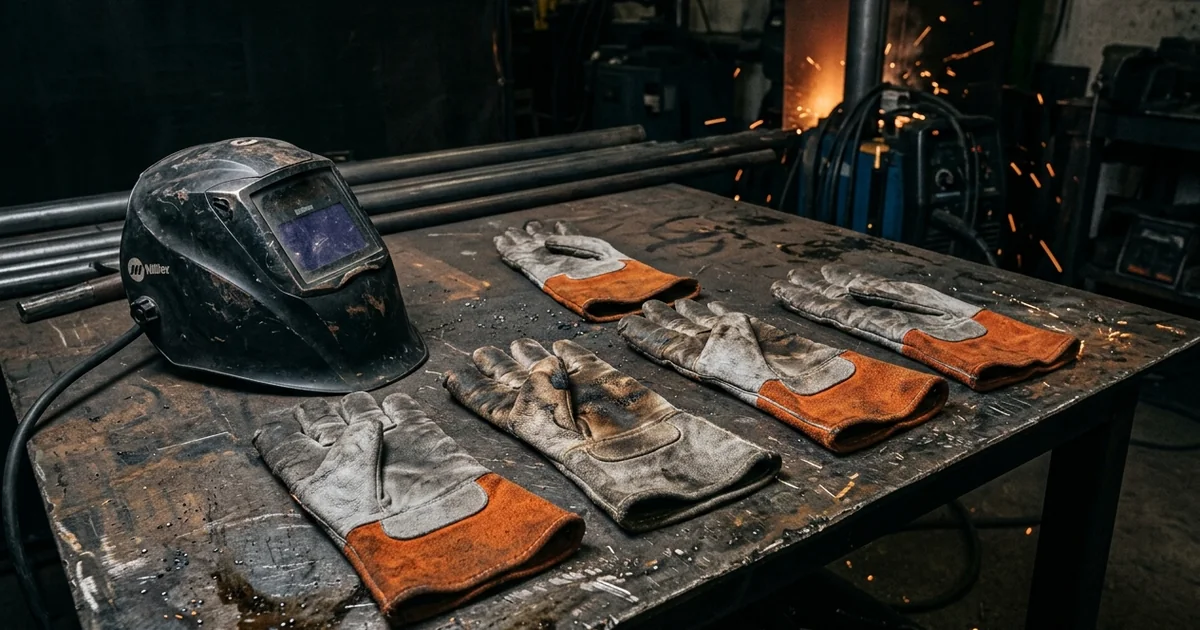
If you want one straightforward answer, my top FR glove here is the Revco 850 Black Stallion Flame-Resistant Elkskin Welding Glove — it's the most flame-resistant build in this group, with a Nomex-lined back, Kevlar thread, and welted seams. But "best FR glove" depends entirely on the job: a MIG welder chasing dexterity, a stick welder soaking up radiant heat, and someone taking impacts on a fab table all want different gloves. One thing up front, because it matters for safety: every glove in this guide is welding leather, and none of them publish an arc rating. "Flame-resistant" means a material that resists ignition, self-extinguishes when the flame is removed, and won't melt onto skin — it does not mean fireproof, and it does not automatically mean arc-rated. If you specifically need arc-flash protection, read the standards distinction below before you buy.
Key Takeaways
- None of these gloves are arc-rated. They're FR welding gloves; no ATPV (cal/cm²), NFPA 2112, or NFPA 70E rating is stated on any listing. Arc-flash work needs arc-rated PPE — see arc-rated vs. flame-resistant.
- Match leather to the heat and the task. Elkskin and cowhide hold up to sustained heat; thin goatskin trades heat mass for dexterity. The protective gap that I weigh most is the lining and the thread, not the brand.
- Kevlar stitching is the quiet differentiator. Seams blow out before the leather does. Every pick here uses FR Kevlar thread — that's why they're on the list and bargain-bin gloves aren't.
- Gloves are one layer. They protect your hands; your sleeves and torso need their own FR — start with what FR clothing actually is and, for welders, FR clothing for welders.
- Buy budget gloves to burn through. Welding gloves are consumable. A $14 pair you replace often can be the right call next to a $40 pair you baby.
How I ranked these (protection first, not commission)
I rank on protection first, then value, then fit — and for a safety category I let the better-protecting glove win its spot regardless of whether I earn on it. I only quote a spec when the product listing actually states it. Where a listing doesn't state a number — fabric weight, ATPV cal/cm², NFPA 2112, ASTM F1506, or an inherent-vs-treated label — I write "not stated" or "—" rather than borrow a figure from another model or invent one. That discipline matters most here: a glove's flame story is built from its leather, its lining, and its thread, and I'd rather tell you exactly what the manufacturer claims than dress it up. None of these five list an arc rating, so none of them gets one in my table. Where I'm describing real-world feel — heat soak, dexterity, seam life — that's my read as a reviewer, stated as opinion, not a lab result.
| Pick | Fabric / weight | Arc rating (if stated) | Best for | Price |
|---|---|---|---|---|
| 1. Revco 850 Elkskin | Grain elkskin; Nomex back lining; oz weight — | — | Best overall FR build | $39.00 |
| 2. GS1715 BT Impact | Split cowhide palms; FR liner patches; oz weight — | — | Impact + heavy fab work | $65.99 |
| 3. GM1510 WT Goatskin MIG | Grain goatskin palm / split cowhide back, lined; oz weight — | — | Dexterity (MIG / light TIG) | $20.99 |
| 4. GS1321 BG Long Cuff | Stick split cowhide; CushionCore lined, insulated; oz weight — | — | Heat-soak stick welding | $25.99 |
| 5. 110 Cowhide Split | Shoulder split cowhide; cotton sock-lined; oz weight — | — | Budget / consumable | $14.00 |
1. Revco 850 Black Stallion Flame-Resistant Elkskin Welding Gloves — best overall FR build
This is the glove I'd hand someone who wants the most flame-resistant construction without overthinking it. The back is lined with flame-resistant Nomex, it's stitched with flame-resistant Kevlar thread, and the seams are welted — strips of leather sewn over the seam so sparks don't find the stitching. Elkskin is the bonus: it stays soft and resists stiffening up the way cheaper cowhide can. The honest caveat is the same one that applies to the whole list — the listing labels it "Fire Resistant" but states no arc rating, no NFPA standard, and no fabric weight, so treat it as welding leather, not arc-flash PPE.
- Pros: Nomex back lining and Kevlar thread are the two things that actually fail first on lesser gloves; supple elkskin; welted seams; sizes S–XL.
- Cons: No arc rating, NFPA, or ATPV stated; oz weight not stated; $39 is mid-pack, so not a "burn through them" price.
Check price at Working Person's Store →
2. Black Stallion GS1715 BT Impact-Resistant Welding Gloves — best for impact and heavy fab
If you're stick welding and also taking knocks — dragging steel, dropping plate, working a crowded fab table — this is the pick. It pairs split cowhide palms and fingertips with FR liner patches, knuckle protection, and impact-resistant cowhide, plus the trademarked DragPatch palm inserts and RestPatch wrist features that take abuse on a workbench. The trade-off is honesty about the FR: protection here comes from FR liner patches rather than a full Nomex lining like the Revco, and no arc rating or NFPA number is stated. It's also the most expensive and the bulkiest, so cross it off if you need finesse.
- Pros: Knuckle and impact protection none of the others have; DragPatch/RestPatch reinforcement; durable cowhide build.
- Cons: FR via liner patches, not a full lining; bulkiest, so worst dexterity; $65.99 is the priciest here; no arc rating, ATPV, or weight stated.
Check price at Working Person's Store →
3. Black Stallion GM1510 WT White Goatskin MIG Welding Gloves — best dexterity
When the work is MIG or lighter TIG and you need to feel the wire and trigger, thin goatskin wins. The grain goatskin palms are soft and supple over split cowhide backs, it's fully lined for heat, and the seamless index fingers plus Kevlar stitching keep the most-used parts intact. This is as close to bare-handed as a welding glove on this list gets. The catch is physics: thin leather carries less heat mass than elkskin or cowhide, so it's not the glove for sustained high heat or heavy stick work — and, like the rest, no arc rating is stated. At $20.99 in sizes through 2XL, it's an easy second pair to keep for fine work.
- Pros: Best feel and finger dexterity here; fully lined; seamless index fingers; Kevlar stitching; widest size range (SM–2XL).
- Cons: Thin leather = less heat mass, not for heavy/sustained heat; white palms show wear fast; no arc rating, NFPA, or weight stated.
Check price at Working Person's Store →
4. Black Stallion GS1321 BG Blue Long Cuff Cowhide Welding Gloves — best for heat-soak stick welding
Stick welding throws a lot of radiant heat, and after a long bead the heat that gets through is what wears you down. This glove leans into comfort for exactly that: CushionCore-lined palms and backs, insulated long cuffs that cover the forearm, Kevlar stitching, and welted seams on stick split cowhide. It's the glove I'd reach for on a long, hot run where I'm not doing anything delicate. Two honest limits: it's offered only in LG and XL, so smaller hands are out of luck, and — same refrain — no arc rating or NFPA standard is stated.
- Pros: CushionCore lining and insulated long cuff blunt radiant heat and protect the forearm; reinforced palms; Kevlar stitching with welted seams.
- Cons: Only LG and XL — no smaller sizes; bulky cuff hurts dexterity; no arc rating, ATPV, or fabric weight stated.
Check price at Working Person's Store →
5. Black Stallion 110 Cowhide Standard Split Welding Gloves — best budget / consumable
At $14, this is the honest grab-bag pick: shoulder split cowhide, fully sock-lined with cotton, stitched with flame-resistant Kevlar, and finished with spark-resisting welts on the seams and gauntlet cuffs. It does the basics — occasional welding, grinding, general shop handling — without pretending to be more. The cotton sock lining gives less heat protection than the Nomex-lined Revco or the CushionCore long-cuff above, and there's no arc rating stated, but that's the deal you're making for the price. Buy several pairs and rotate them out as they char; that's the right way to use a glove this cheap.
- Pros: $14 — buy them to burn through; FR Kevlar stitching and spark welts; sizes S–XL; cotton sock lining for everyday comfort.
- Cons: Cotton lining = least heat protection on this list; basic split cowhide stiffens with heat; no arc rating, NFPA, ATPV, or weight stated.
Check price at Working Person's Store →
Are welding gloves the same as arc-rated gloves?
No — and conflating them is the one mistake that can actually hurt you. Welding leather gloves like every pick on this list are built to resist heat, sparks, and spatter; their flame resistance comes from the leather plus FR linings (Nomex) and FR thread (Kevlar). An arc rating is a separate, tested value — measured in cal/cm² as an ATPV — that tells you how much incident energy a material can take in an electrical arc-flash event before the onset of second-degree burn. None of the listings here state an ATPV, an NFPA 2112 (flash fire) rating, an NFPA 70E reference, or an ASTM F1506 mark, so I treat all five as welding/general-FR gloves, full stop. For context on the protection categories you'll see in arc-rated PPE: CAT 1 is at least 4 cal/cm², CAT 2 at least 8, CAT 3 at least 25, and CAT 4 at least 40 — but those only apply to garments that actually publish the rating. If your work involves energized electrical equipment, don't substitute welding gloves for arc-rated gloves; start with the arc-rated vs. flame-resistant breakdown.
Frequently Asked Questions
Are any of these FR gloves arc-rated?
No. None of the five gloves in this guide state an arc rating, ATPV (cal/cm²), NFPA 2112, NFPA 70E, or ASTM F1506 mark on their listing. They are flame-resistant welding leather gloves, not arc-flash PPE. For energized electrical work you need gloves that specifically publish an arc rating.
Which FR glove is the best overall?
For overall flame-resistant construction I rank the Revco 850 Black Stallion Elkskin glove first, because it combines a flame-resistant Nomex back lining, Kevlar thread, and welted seams. But the "best" glove depends on the job: pick the goatskin GM1510 for dexterity, the GS1715 BT for impact protection, or the $14 110 split cowhide as a consumable.
What leather is best for welding gloves?
It depends on the heat and the task. Elkskin and cowhide carry more heat mass and resist sustained heat, which suits stick welding and heavy work; soft goatskin is thinner and far more dexterous, which suits MIG and light TIG. Thicker leather protects more but feels clumsier — match the leather to the job rather than chasing one "best."
Do Kevlar and Nomex make a glove flame-resistant?
Kevlar and Nomex are inherently flame-resistant materials, and on these gloves they appear as Kevlar stitching thread and, on the Revco 850, a Nomex back lining. That reinforces the parts that fail first — the seams and the back of the hand. However, a few FR components do not equal a tested standard: none of these listings state an NFPA or arc rating, so the gloves are FR-constructed welding leather rather than rated PPE.
How often should I replace welding gloves?
Replace welding gloves as soon as you see charred or split seams, holes, hardened leather, or any spot where heat is getting through to your skin. Because they are consumable, many welders keep a cheap pair like the $14 110 split cowhide in rotation to burn through and a better-built pair for longer or hotter work.
Why Trust This Guide
This guide was written and reviewed by Wes Calder, an independent flame-resistant-workwear reviewer. My approach is methodology, not marketing: I read the standards, pull the actual product listings, and only state a spec — fabric, lining, thread, NFPA or arc rating — when the manufacturer's listing states it. Where a number isn't published, I say so rather than guess, which is why this entire guide is honest that none of these gloves carry a stated arc rating. FR Gear Lab earns a commission on some links, but we never rank by commission over safety; in a category where a wrong rating can get someone burned, the better-protecting product wins its spot. See our affiliate disclosure for details.