
Key Takeaways
- There's no true certified "FR lab coat" in this catalog. The closest FR garment is the Bulwark JEL2 work jacket; everything else is an FR coat, an FR welding jacket, or an anti-static lab coat that is not FR.
- FR and arc-rated are not the same thing. A garment can meet flash-fire standards without publishing an arc rating — read arc-rated vs. flame-resistant before you buy for electrical work.
- The white "lab jacket" on most sites is anti-static, not FR. The Red Kap ESD coat is 93% polyester — polyester can melt — and states no FR or arc rating. I included it to document that trap.
- NFPA 2112 (flash fire) is separate from an arc rating (cal/cm²). Only some listings publish a clean ATPV number; where one isn't stated, I write "—" rather than borrow a figure. See what is FR clothing.
- Match the garment to the hazard. Lab/electrical layering, outdoor cold-weather utility, and welding are three different jobs — see how this maps in FR clothing for oil and gas.
How I ranked these (protection first, not commission)
I quote a spec only if the product listing actually states it. Where a listing doesn't publish a fabric weight, an ATPV in cal/cm², an NFPA standard, or whether the fabric is inherent vs. treated, I write "not stated" or "—" — I never invent a number, and I never borrow one model's arc rating for another. That matters more here than in most categories, because the word "lab coat" pulls in garments that look right but aren't flame resistant at all. My order is protection first (what's certified, and to what), then value, then how well the cut actually fits the lab/electrical use case. I earn a commission on some links, but ranking follows merit, not payout — the welding jacket is cheap and I still rank it low for this search because it isn't built for arc or flash-fire hazards.
| Pick | Fabric / weight | Arc rating (if stated) | Best for | Price |
|---|---|---|---|---|
| 1. Bulwark JEL2 FR Work Jacket | Excel FR, 100% cotton twill (treated), 9 oz | CAT/HRC 2 stated; exact ATPV ambiguous on listing (CAL 8+ vs 61.3) | Lab & electrical FR layering | $102.49 |
| 2. Carhartt 102182 Navy FR Quick Duck Coat | FR Quick Duck, 88% cotton / 12% nylon, 8.5 oz | — (CAT 3 stated; no clean ATPV) | Outdoor cold-weather utility | $279.99 |
| 3. Carhartt 102182 Brown Full Swing FR Coat | Quick Duck, 88% cotton / 12% nylon + 150g Thinsulate; oz — | — (CAT 3 stated; no clean ATPV) | Cold-weather utility, more mobility | $279.99 |
| 4. Black Stallion BX9C FR Welding Jacket | Fire-resistant cotton, 9 oz | — | Welding / metal shops (not arc/flash) | $37.99 |
| 5. Red Kap KK26 White ESD Lab Jacket | 93% polyester / 7% carbon nylon (ESD, anti-static) | — (NOT FR / not arc-rated) | Static-sensitive electronics — not FR | $52.19 |
1. Bulwark JEL2 FR Work Jacket — best for lab & electrical FR layering
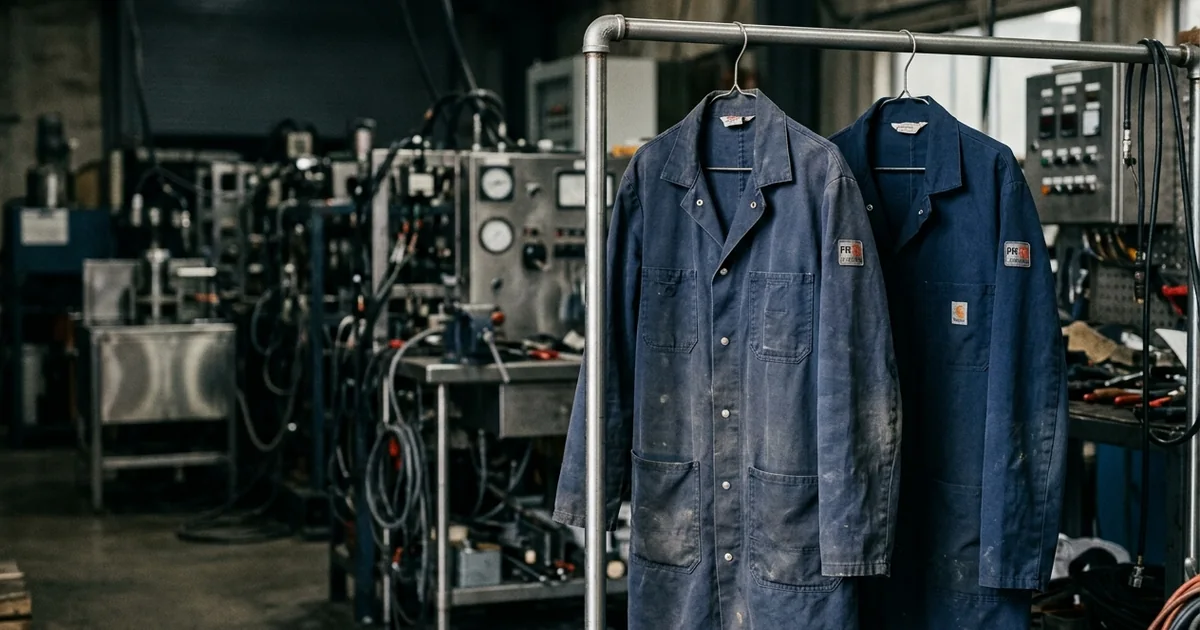
This is the most lab-coat-like FR garment on the site: a thin 9 oz Excel FR cotton-twill jacket you can throw over a work shirt or scrubs without the bulk of an insulated coat. The listing states NFPA 70E and CAT/HRC 2, which is the right neighborhood for a lot of lab and lower-energy electrical tasks. The catch is honesty about the number: the page is internally inconsistent on the exact arc rating — a CAL 8+/CAT 2 spec field versus a "61.3 cal/cm²" line in the body copy — so I treat the precise ATPV as ambiguous and tell you to confirm the sewn-in label before relying on a figure. Excel FR is a treated (chemically flame-resistant) cotton, not inherent.
- Pros: Lightest, most lab-coat-shaped FR option here; NFPA 70E and CAT/HRC 2 stated; layers easily over other clothing.
- Cons: Exact ATPV ambiguous on the listing (CAL 8+ vs 61.3) — verify the label; treated rather than inherent FR; navy, not a white lab-coat look.
Check price at Working Person's Store →
2. Carhartt 102182 Navy FR Quick Duck Coat — best for outdoor cold-weather utility
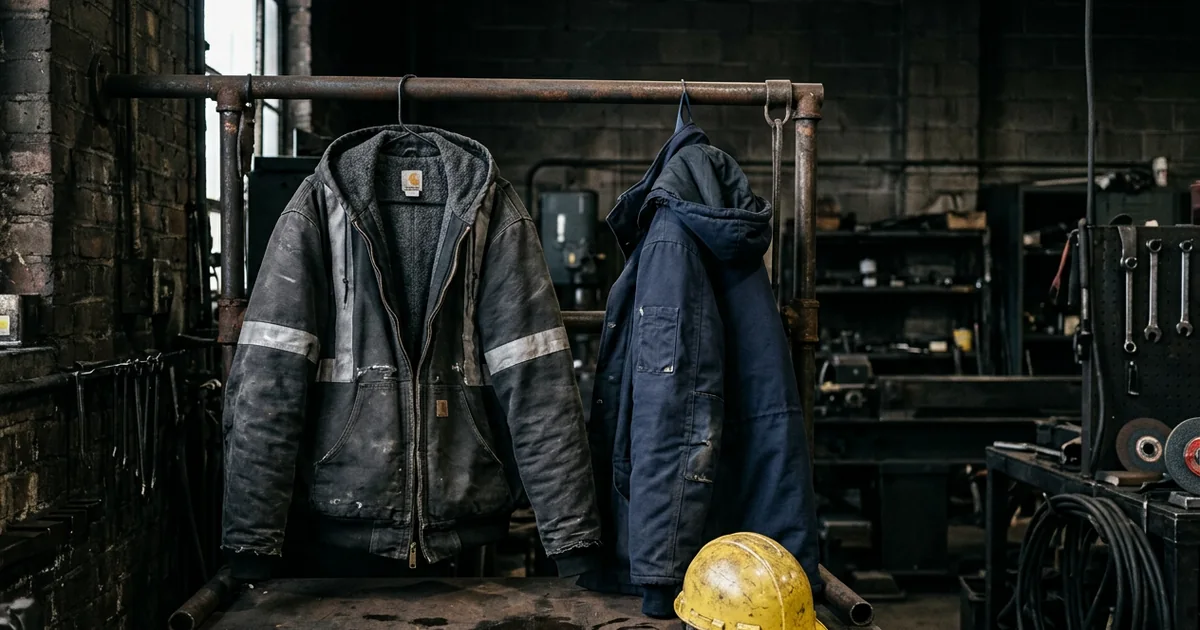
If "coat" to you means cold-weather outerwear rather than a lab smock, this is the strongest documented pick. The listing is unusually clean on standards: 8.5 oz FR Quick Duck (88% cotton / 12% nylon), UL Classified to NFPA 2112, meets NFPA 70E, with CAT 3 labels sewn onto the left chest pocket. That's a real flash-fire-certified coat. The honest trade-off is that it's insulated and bulky — exactly wrong for a temperature-controlled lab — and it does not publish a clean ATPV cal/cm² figure, so the arc number stays "—" here despite the strong NFPA documentation.
- Pros: UL Classified to NFPA 2112 and NFPA 70E stated; CAT 3; built for genuine cold-weather utility and electrical work outdoors.
- Cons: Insulated and bulky — not a lab garment; no clean ATPV stated; inherent-vs-treated not stated; premium price.
Check price at Working Person's Store →
3. Carhartt 102182 Brown Full Swing FR Coat — best for cold work with more mobility
This is the brown, Full Swing sibling of the navy FR Quick Duck coat. Same core protection story per the listing — Quick Duck canvas (88% cotton / 12% nylon), 150-gram 3M Thinsulate Platinum insulation, UL classified to NFPA 2112, CAT 3 — with a mobility-focused back for reaching and climbing. I rank it just behind the navy because this color page doesn't state the shell's oz weight, so there's marginally less documented on the page itself. It's a legitimate insulated FR coat; it is still not a lab coat, and like the navy it publishes no clean arc number.
- Pros: UL classified to NFPA 2112 and NFPA 70E; CAT 3; Full Swing mobility plus 150g Thinsulate for genuine cold; brown colorway.
- Cons: Shell oz weight not stated on this page; insulated/bulky (not for labs); no ATPV stated; inherent-vs-treated not stated.
Check price at Working Person's Store →
4. Black Stallion BX9C FR Welding Jacket — best for welding, not lab work
At under $40 this is the budget FR layer, but be honest about what it is: a 9 oz fire-resistant cotton welding jacket built to shrug off spatter and slag, not an arc-rated or flash-fire-certified garment. The listing names "ASTM" as a feature but gives no standard number, and states no NFPA 2112, no NFPA 70E, and no arc rating. For a lab or electrical buyer that's a real gap. I include it for welders and metal shops where it genuinely belongs — and rank it low for the FR lab coat search, because cheap is the wrong reason to put it between you and an arc.
- Pros: Cheapest FR layer here; 9 oz fire-resistant cotton; purpose-built for welding spatter and slag.
- Cons: No NFPA 2112, no NFPA 70E, no arc rating, no specific ASTM number stated; not appropriate for arc-flash or lab use.
Check price at Working Person's Store →
5. Red Kap KK26 White ESD Lab Jacket — the lab coat that isn't FR
This is the garment that looks most like a lab coat — white, 33 inches, the classic silhouette — and that is exactly why it's last and flagged. It is an ESD (anti-static) lab jacket made of 93% texturized polyester and 7% carbon-suffused nylon, with no NFPA 2112, no NFPA 70E, and no arc rating stated. Polyester can melt onto skin, and an anti-static coat does nothing for an arc flash. If you searched "FR lab coat" and were one click from buying a white lab jacket, read this paragraph first. It's a solid coat for static-sensitive electronics work — it is the wrong tool for any FR or arc hazard.
- Pros: A genuine lab-coat cut and length; ESD/anti-static fabric for static-sensitive electronics; the familiar white look.
- Cons: NOT flame resistant; 93% polyester can melt; no NFPA 2112 / 70E / arc rating; do not use where flash-fire or arc-flash is a hazard.
Check price at Working Person's Store →
Why is a true FR lab coat so hard to find?
The classic white lab coat comes from sectors — chemistry, healthcare, electronics — where the main hazard is splashes or static, not fire. So most "lab coats" are cotton/poly blends or anti-static ESD fabrics, neither of which is flame resistant. Real FR garments, meanwhile, are built for the trades that face flash fire and arc flash (oil and gas, welding, electrical), and those come as shirts, coveralls, jackets, and coats — not the lab-coat silhouette. The practical answer for lab or electrical work that needs FR is to wear a certified FR layer like the Bulwark JEL2 jacket rather than a white anti-static coat, and to match the garment's stated NFPA 70E / arc rating to your task's energy. If you need the white-coat look and FR, that's a specialty order from an FR uniform program — and it should still carry a stated standard and rating you can verify on the label.
Frequently Asked Questions
Is a regular white lab coat flame resistant?
Usually no. Most white lab coats are cotton/poly blends or anti-static (ESD) fabrics built for splashes and static, not fire. The Red Kap ESD lab jacket here is 93% polyester and states no FR or arc rating — polyester can melt onto skin, so it should not be used where flash-fire or arc-flash is a hazard.
What's the difference between FR and arc-rated for lab work?
"Flame resistant" means the fabric resists ignition and self-extinguishes. "Arc-rated" means the garment has been tested and assigned a cal/cm² value (ATPV) for electrical arc exposure. All arc-rated clothing is FR, but not all FR clothing publishes an arc rating. For electrical lab work, look for a stated NFPA 70E / arc rating, not just the word "FR."
Does NFPA 2112 mean a garment is safe for electrical work?
Not by itself. NFPA 2112 certifies flash-fire performance, which is common in oil and gas. Electrical/arc-flash hazards are addressed under NFPA 70E with an arc rating in cal/cm². A coat can be UL Classified to NFPA 2112 yet not publish an arc rating, so check both for your specific hazard.
Is CAT 2 (HRC 2) enough for my task?
It depends on your arc-flash incident energy. CAT 1 is ≥4 cal/cm², CAT 2 is ≥8, CAT 3 is ≥25, and CAT 4 is ≥40 cal/cm². You must match the garment's stated category to the incident energy from your facility's arc-flash study — never guess. The Bulwark jacket states CAT/HRC 2; the Carhartt coats state CAT 3.
Does treated vs. inherent FR matter?
Both can be certified and protective. Inherent FR is woven from fibers that are flame resistant by nature; treated FR (like the Bulwark's Excel FR cotton) is chemically made flame resistant. What matters most is the stated standard, the arc/flash rating, and following the care instructions so the protection lasts. Where a listing doesn't state which it is, I mark it "not stated" rather than guess.
Why Trust This Guide
This guide was written and reviewed by Wes Calder, an independent flame-resistant-workwear reviewer who reads the actual product listings and quotes only the specs they state — marking everything else "—" rather than filling gaps with numbers. FR is safety gear, so I won't imply an arc rating a listing doesn't publish, and I flag the anti-static "lab coat" that isn't FR at all. We earn a commission on some links, but we never rank by commission over safety — see our affiliate disclosure.