
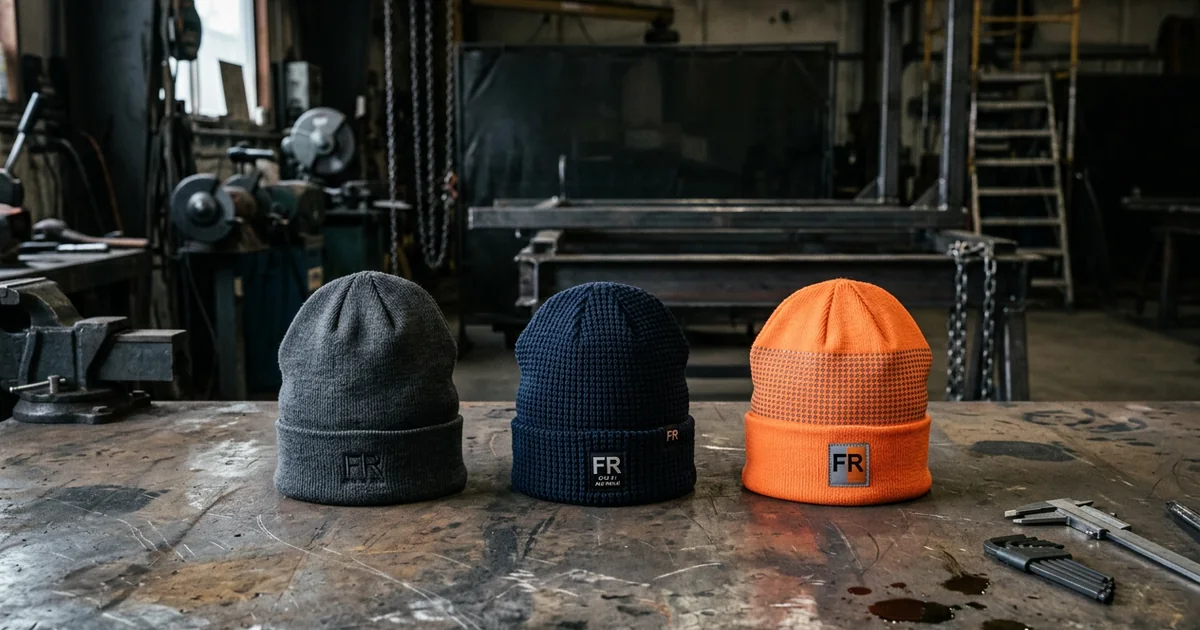
Key Takeaways
- Only one published an arc rating. The Ariat Iron Gray beanie states ATPV 15 cal/cm² (CAT 2); the others don't, so I don't pretend they do — see my full FR beanie and winter hat guide.
- NFPA 2112 ≠ arc rating. NFPA 2112 covers flash fire; arc flash (cal/cm²) is a separate test. Read what each really means in what FR clothing actually is.
- All three are modacrylic-based FR fibers. These are inherent-fiber blends, not topical treatments that wash out — the FR is built into the yarn.
- Dragonwear wasn't verifiable, so I substituted honestly. Carhartt's knit beanie pages are dead, so the verified Carhartt headwear is a balaclava — different shape, more coverage. If you want a hood-style option, see my FR balaclava guide.
- Price is tight: $39.95–$42.99. Protection per dollar, the Ariat beanies win.
How I ranked these (protection first, not commission)
I rank on stated protection first, then value, then fit — never on what pays me more. The hard rule I follow on safety gear: I only quote a spec if the product's own listing states it. Where a listing doesn't publish a number — fabric weight, ATPV cal/cm², or the literal word "inherent" — I write "not stated" or "—" instead of borrowing a figure from a similar model. That matters here because the same Ariat beanie is sold in two colorways, and one listing prints the certification figures while the other doesn't. I report each exactly as its own page reads. I also won't link a product I can't pull up live: Carhartt's FR knit watch hat (102869) and FR fleece 2-in-1 hat (103519) are indexed by Google but their pages return 404 right now, and I couldn't find a verifiable Dragonwear FR beanie listing at all. So the Carhartt entry below is its FR knit balaclava — a different garment shape, flagged as such.
| Pick | Fabric / weight | Arc rating (if stated) | Best for | Price |
|---|---|---|---|---|
| Ariat 10027909 Iron Gray FR Polartec Beanie | 43% rayon / 39% modacrylic / 14% aramid / 4% spandex; Polartec Power Grid. Weight — | ATPV 15 cal/cm² (CAT 2); NFPA 2112 + 70E stated | Documented arc rating on a true beanie | $39.95 |
| Carhartt 103520 Dark Navy FR Force Balaclava | 45% modacrylic / 35% lyocell / 20% aramid. Weight — | — (no ATPV stated); UL classified to NFPA 2112 + meets 70E | Full face + neck coverage in wind | $42.99 |
| Ariat 10018117 Black FR Polartec Beanie | 43% rayon / 39% modacrylic / 14% aramid / 4% spandex; Power Grid. Weight — | — (not stated on this black listing) | All-black true beanie, value | $39.95 |
1. Ariat 10027909 Iron Gray FR Polartec Beanie — best for a documented arc rating
This is the one I reach for when the job needs paperwork, not just warmth. The Iron Gray listing is the only headwear here that explicitly states an arc rating — ATPV 15 cal/cm², a CAT 2 item — on top of NFPA 70E and NFPA 2112 certification. The 43% rayon / 39% modacrylic / 14% aramid / 4% spandex blend uses Polartec Power Grid and DuraStretch, so it's stretchy, breathable, and wicks. The honest trade-off: at 15 cal/cm² it's CAT 2, fine for many tasks but below CAT 3/4 work, and fabric weight isn't published, so I can't tell you exactly how warm it runs versus a thicker knit.
- Pros: Only pick with a stated ATPV (15 cal/cm², CAT 2); NFPA 2112 + 70E stated; stretchy, moisture-wicking Polartec blend; $39.95.
- Cons: Fabric weight not stated; CAT 2 ceiling (not for higher-incident-energy work); confirm the cal/cm² figure on the live listing before relying on it.
Check price at Working Person's Store →
2. Carhartt 103520 Dark Navy FR Force Balaclava — best for face and neck coverage
Two things to be straight about: this is a balaclava, not a beanie, and I'm using it because Carhartt's actual FR knit beanie pages are dead links right now — I won't send you to a product I can't verify. As a head covering it does more than a beanie, wrapping face and neck, which is the right call when wind chill and exposed skin are the real hazard. The 45% modacrylic / 35% lyocell / 20% aramid blend is UL classified to NFPA 2112 and meets NFPA 70E, with FastDry moisture-wicking and odor control. The trade-off: no ATPV/arc rating is published, so don't assume one, and a balaclava is warmer and more enclosing than some people want under a hard hat.
- Pros: Full face + neck coverage; UL classified to NFPA 2112, meets 70E; modacrylic/lyocell/aramid FR fibers; FastDry wicking + odor control.
- Cons: Not a beanie (different shape); no arc rating stated; fabric weight not stated; most enclosed/warmest of the three.
Check price at Working Person's Store →
3. Ariat 10018117 Black FR Polartec Beanie — best value all-black beanie
This is the same Ariat FR Polartec beanie as my top pick, just in black, at the same $39.95 — and the fabric is identical: 43% rayon / 39% modacrylic / 14% aramid / 4% spandex with patented Power Grid construction that's breathable and moisture-wicking. The one reason it sits at #3 instead of #1 is documentation, not material: this black listing describes "permanent flame resistance" but does not restate the NFPA 2112/70E certs, the CAT level, or the ATPV figure that the Iron Gray page prints. The FR fibers don't change between colorways, but I rate what each page actually states — so if you need those numbers in writing on the listing you buy from, get the Iron Gray SKU instead.
- Pros: Identical FR blend and Power Grid construction; permanently flame-resistant inherent fibers; all-black; $39.95.
- Cons: This listing does not state NFPA 2112/70E, CAT, or ATPV; fabric weight not stated; for documented specs, buy the Iron Gray colorway.
Check price at Working Person's Store →
Does NFPA 2112 mean a beanie is arc-rated?
No, and conflating them is how people end up under-protected. NFPA 2112 certifies a garment against industrial flash fire — a sudden, brief engulfment. Arc flash is a different hazard with a different test (ASTM F1959), reported as an ATPV or EBT in cal/cm² and bucketed into CAT/HRC levels: CAT 1 ≥ 4, CAT 2 ≥ 8, CAT 3 ≥ 25, CAT 4 ≥ 40 cal/cm². A hat can be NFPA 2112 certified for flash fire yet publish no arc rating at all — which is exactly the case for the Carhartt balaclava and the black Ariat listing here. Only the Iron Gray Ariat states a cal/cm² figure (15, CAT 2). If your job hazard analysis specifies an incident-energy level, match the stated rating to it and don't infer a number a listing never gave you.
Frequently Asked Questions
Which FR beanie is best overall?
The Ariat 10027909 Iron Gray FR Polartec Beanie is my overall pick because its listing is the only one that states an arc rating — ATPV 15 cal/cm², CAT 2 — alongside NFPA 2112 and 70E, at $39.95.
Why isn't there a Dragonwear beanie in this comparison?
I couldn't source a live, verifiable Dragonwear FR beanie listing to quote specs from, and I won't invent product details on safety gear. Rather than fabricate one, I compared the verified Ariat beanies and substituted a verified Carhartt FR balaclava as a close alternative, flagged as a different garment shape.
Are these FR beanies arc-rated?
Only the Ariat Iron Gray listing states an arc rating (ATPV 15 cal/cm², CAT 2). The Carhartt balaclava and the black Ariat listing do not publish an ATPV, so I report their arc rating as not stated — NFPA 2112 certification is for flash fire, not arc flash.
Are these inherent FR or treated?
All three are modacrylic-based fiber blends, meaning the flame resistance is built into the yarn and won't wash out. The listings describe them as permanently flame-resistant; most don't use the literal word "inherent," but these are inherent-fiber blends rather than topical treatments.
Beanie or balaclava — which should I get?
Choose a beanie like the Ariat for a warm head under a hard hat with a published arc rating. Choose the Carhartt balaclava when wind chill and exposed face and neck skin are the hazard, accepting that it's warmer, more enclosed, and publishes no arc rating.
Why Trust This Guide
This guide was written and reviewed by Wes Calder, an independent flame-resistant-workwear reviewer. I quote only specs each product's own listing states, mark everything else with "—," and won't link a product I can't pull up live — which is why a dead Carhartt beanie page and an unverifiable Dragonwear listing are handled as substitutions rather than invented specs. We earn a commission on some links, but we never rank by commission over safety — see our affiliate disclosure.