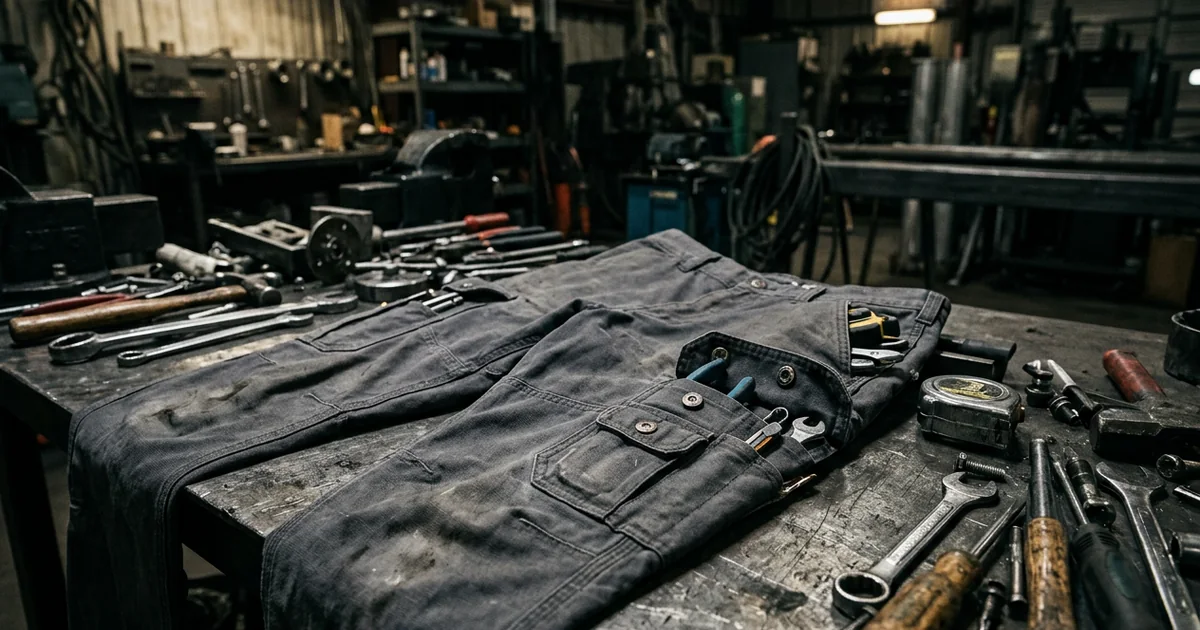

The best FR pants for most people are the pair that hits the arc rating your job actually requires, fit well enough that you'll keep wearing them through a hot shift, and don't cost so much you stretch one pair past its life. For most tradespeople that's the Wrangler RIGGS FR3W020 — a published 23.7 cal/cm² ATPV with four-standard compliance for under $80. But "best" depends on whether you need summer breathability, a high arc rating, cargo pockets, or stretch to squat in, so I've ranked six pairs by what each one is honestly best for. What is FR clothing? Fabric that resists ignition, self-extinguishes, and won't melt onto skin — not "fireproof."
Key Takeaways
- FR is not arc-rated by default. Every pair here meets NFPA 2112 (flash-fire), but only some publish an arc rating in cal/cm². If you work an arc-flash job, you need that cal number — see arc-rated vs. flame-resistant.
- The value champ is a jean. The Wrangler RIGGS FR3W020 publishes the highest arc rating in this set (23.7 cal/cm², HRC 2) at the lowest price tier — heavy 14.5 oz cotton is the trade-off.
- Cooler usually means lower cal — but not always. Lighter canvas breathes better; here the lightest builds are the 9 oz Carhartt canvas pants, which publish CAT 2 but no cal number, while the hot 14.5 oz denim publishes the highest cal.
- Stretch is rare and worth it if you bend all day. Only the Carhartt Rugged Flex pants here have 2% spandex. Pay attention to whether a "cooler" pair actually states its arc rating before you trade protection for comfort.
- Inherent vs. treated affects care, not whether it's certified. Both pass NFPA 2112; treated cotton just depends on correct laundering over its life — see inherent vs. treated FR.
How I ranked these (protection first, not commission)
FR pants are safety gear, so I rank on protection and honest value before anything else: a published arc rating beats an unstated one, a stated fabric weight beats a blank, and dual or four-standard compliance beats a single line of fine print. Then I weigh fit, breathability, and price for the job you're actually doing. I only quote a spec when the garment's own listing states it — where a page doesn't publish a cal/cm² number or a weight, you'll see "—" rather than a number I borrowed from a different model. Every pair below is reachable through Working Person's Store; I earn a commission on some links, but the order is merit, not payout.
| Pick | Fabric / weight | Arc rating (if stated) | Best for | Price |
|---|---|---|---|---|
| Wrangler RIGGS FR3W020 | 100% cotton FR denim / 14.5 oz | ATPV 23.7 cal/cm², HRC 2 | Best overall / tool-carrying | $77.99 |
| Bulwark PLW2NV | 88/12 cotton-nylon twill / — | ATPV 12.2 cal/cm², HRC 2 | Best value work pant | $75.99 |
| Ariat M4 Workhorse | 88/12 cotton-nylon canvas / 11 oz | ATPV 12.7 cal/cm², CAT 2 | Rugged canvas, published cal | $129.95 |
| Carhartt 104986 Rugged Flex | 98% cotton / 2% spandex canvas / 9 oz | CAT 2 (cal/cm² not stated) | Stretch / mobility | $124.99 |
| Carhartt 104205 Rugged Flex Cargo | 98% cotton / 2% spandex canvas / 9 oz | CAT 2 (cal/cm² not stated) | Best FR cargo | $134.99 |
| MCR Safety PT2T | 88/12 cotton-nylon / — | ATPV 8.6 cal/cm², CAT 2 | Basic NFPA 2112 pant | $106.99 |
1. Wrangler RIGGS FR3W020 — best FR pants overall
For a job that carries tools and an arc-flash hazard, this is the one I'd reach for. The listing publishes a 23.7 cal/cm² ATPV at HRC 2 — the highest published arc rating in this group — plus four-standard coverage (NFPA 2112, NFPA 70E, ASTM F1506, OSHA 1910.269). The carpenter cut adds a hammer loop and utility pockets, and at $77.99 it sits near the bottom of the price range and the top of the protection range. The honest trade-off is heat: 14.5 oz of treated 100% cotton denim is heavy, stiff before break-in, and warm in summer, so its protection rides on correct laundering. Want the same rating in a roomier seat and thigh? The relaxed-fit Wrangler FR jeans share this rating class — see the best FR jeans guide.
- Pros: Highest published arc rating here (23.7 cal/cm²); four-standard compliance; carpenter utility pockets; low price.
- Cons: Heavy, hot 14.5 oz all-cotton denim; stiff before break-in; jean cut, not a canvas cargo; treated, so care matters.
Check price at Working Person's Store →
2. Bulwark EXCEL FR Twill Work Pant (PLW2NV) — best value
This is the one I'd hand a new hire who needs a real NFPA 2112 pant without overspending. The page is explicit that it's Bulwark's Excel-FR treated 88/12 cotton-nylon twill, publishing a 12.2 cal/cm² ATPV at HRC 2 — solid CAT 2 protection — for $75.99, the lowest price in the set. Cotton-nylon twill is more comfortable and less stiff than heavy all-cotton denim, which makes it an easy daily-wear pant. Two honest gaps: the listing doesn't state a fabric weight, so you can't judge abrasion durability from the spec sheet, and the FR is a finish rather than an inherent fiber. Neither changes the certification.
- Pros: Lowest price here with a published 12.2 cal ATPV and NFPA 2112; comfortable cotton-nylon twill; clean work-pant cut.
- Cons: No stated fabric weight; treated finish, not inherent FR.
Check price at Working Person's Store →
3. Ariat M4 Workhorse FR — best rugged canvas with a published cal rating
The Ariat M4 Workhorse is the most fully-specced canvas pant in this lineup: it states a real 12.7 cal/cm² ATPV at CAT 2, lists dual NFPA 2112 and 70E compliance, and is built from an 11 oz 88/12 cotton-nylon canvas that can take a beating. Heavier-than-twill canvas plus a printed cal number is exactly what I want when a buyer can't afford to guess at protection. It lands third on price and cut: at $129.95 it's near the top of the range, and the boot-cut lowrise silhouette is a love-it-or-leave-it fit. If you run a tall boot it's a genuine advantage; if you don't, look at the relaxed canvas pants above.
- Pros: Published 12.7 cal/cm² ATPV; dual 2112/70E; rugged 11 oz canvas; weight is actually stated.
- Cons: Pricey at $129.95; boot-cut lowrise won't fit every body or every boot.
Check price at Working Person's Store →
4. Carhartt FR Rugged Flex Canvas Work Pant (104986) — best for stretch and mobility
If your day is squats, ladders, and kneeling, what wears you out isn't the cal rating — it's a pant with no give. The Carhartt Rugged Flex is the only work pant here with 2% spandex woven into a 9 oz FR canvas, and that stretch is genuinely rare in flame-resistant fabric; most FR pants are rigid. It's UL Classified to NFPA 2112 and listed at CAT 2. Here's the straight talk: the page gives CAT 2 but does not publish a cal/cm² number, so if you need to document an arc rating for a specific hazard, you can't confirm it here — pick the Ariat or the Wrangler instead. It also doesn't state inherent vs. treated. But for a CAT 2 job where mobility matters more than a printed cal figure, this is the most comfortable pant in the group.
- Pros: Real 2% spandex stretch for bending and squatting; lighter 9 oz canvas; UL Classified NFPA 2112.
- Cons: CAT 2 listed but no published cal/cm² number; inherent vs. treated not stated; $124.99.
Check price at Working Person's Store →
5. Carhartt FR Rugged Flex Canvas Cargo Pant (104205) — best FR cargo
This is the cargo version of the pick above — grab it if you actually use the pockets, since it adds dedicated phone and utility pockets to the same 9 oz FR canvas with 2% spandex stretch. A true FR cargo is harder to find than you'd think, so it's worth knowing this one is UL Classified to NFPA 2112. The trade-offs carry over: CAT 2 with no published cal/cm² number, so it's not the pant to document a specific arc rating with, and at $134.99 it's the most expensive option here. No need for the pockets? Save the money and take the standard work-pant version. For more cargo-specific picks, see the FR cargo pants guide.
- Pros: True FR cargo with phone/utility pockets; same 2% spandex stretch; UL Classified NFPA 2112.
- Cons: No published cal/cm² number (CAT 2 only); most expensive pant here at $134.99.
Check price at Working Person's Store →
6. MCR Safety PT2T — a basic NFPA 2112 pant, but the value math is off
The MCR Safety PT2T is a standard 88/12 FR cotton-nylon work pant that meets NFPA 2112 and publishes an 8.6 cal/cm² ATPV at CAT 2 — a legitimately certified pant on paper. It lands last because the math doesn't favor the buyer: 8.6 cal/cm² is the lowest arc rating in this set, yet at $106.99 it costs more than the Bulwark, which delivers 12.2 cal for $75.99. The listing also doesn't state a fabric weight. I'd only take it over the Bulwark if it's the cut or color you can actually get in your size.
- Pros: Legitimate NFPA 2112 CAT 2 cotton-nylon pant with a stated 8.6 cal/cm² ATPV.
- Cons: Lowest arc rating here yet priced above the better-rated Bulwark; no stated fabric weight.
Check price at Working Person's Store →
Can FR pants be cooler without cutting protection?
Up to a point — and you have to read the spec, not the marketing. Lighter, more breathable FR fabric helps in heat, and a cotton-nylon twill like the Bulwark wears cooler than 14+ oz all-cotton denim. But "cooler" doesn't automatically mean "less safe"; it's about fabric and weight, not a simple dial. The trap is a lightweight pair that doesn't publish a cal/cm² number at all: the 9 oz Carhartt canvas pants breathe better than the heavy denim but only state CAT 2, while the hot 14.5 oz Wrangler publishes 23.7 cal. So decide the protection level your job requires first — your site's hazard assessment and CAT level — then buy the coolest pair that still meets it. Never trade a documented arc rating for breathability on an arc-flash job.
Frequently Asked Questions
Are all FR pants arc-rated?
No. All arc-rated pants are flame-resistant, but not all FR pants are arc-rated. Every pair in this guide meets NFPA 2112 for flash fire, yet only some publish an arc rating in cal/cm² (ATPV). If your job has an arc-flash hazard, "FR" alone isn't enough — you need a stated arc rating that meets your required CAT level. The Carhartt Rugged Flex pants here list CAT 2 but no cal number, while the Wrangler RIGGS publishes 23.7 cal/cm².
What arc rating (cal/cm²) do I need for my FR pants?
It depends on your site's arc-flash hazard analysis, which assigns a PPE category. As a reference: CAT 1 needs at least 4 cal/cm², CAT 2 at least 8, CAT 3 at least 25, and CAT 4 at least 40. Your employer's hazard assessment sets the required level, not the garment. Match or exceed that number with the pant's published ATPV — and remember a garment's arc rating is the lower of its ATPV and EBT values.
Should I buy inherent or treated FR pants?
Both can be certified to NFPA 2112, so neither is "fake" FR. Inherent FR (aramid, modacrylic) is woven into the fiber and won't wash out; treated FR is a flame-resistant finish on cotton that's engineered to last the garment's usable life if you launder it correctly. Most of the pants in this guide are treated cotton or cotton-nylon. Treated just means care matters more — no bleach, no fabric softener, no starch.
How do I wash FR pants without ruining the protection?
Skip the things that compromise FR fabric: no chlorine bleach, no fabric softener, no hydrogen peroxide, and no starch — all of which can coat fibers or strip the flame-resistant finish. Also wash out heavy grease and oil, because saturated contamination is itself a fire hazard that the FR rating doesn't cover. Follow the garment tag, and see our full guide on how to wash FR clothing for the step-by-step.
What are the best FR pants for hot summer work?
Look for lighter, more breathable fabric that still publishes the arc rating your job requires. In this guide the 9 oz Carhartt Rugged Flex canvas pants are the lightest and add stretch, but they only state CAT 2 with no cal number — fine for a CAT 2 job, not for documenting a specific arc rating. The heavy 14.5 oz Wrangler denim runs hottest but publishes the highest cal. Decide your required protection first, then pick the coolest pair that meets it.
Why Trust This Guide
This guide is written and reviewed by Wes Calder, an independent flame-resistant-workwear reviewer. Every recommendation is built on the published standards (NFPA 2112, NFPA 70E, ASTM F1506), manufacturer spec sheets and garment tags, hands-on handling, and what tradespeople actually report — and we tell you when a number is a manufacturer claim versus an independent standard, and when a garment is FR but not arc-rated. We earn an affiliate commission if you buy through some of our links, at no extra cost to you, and we never rank by commission over safety — see our affiliate disclosure.