
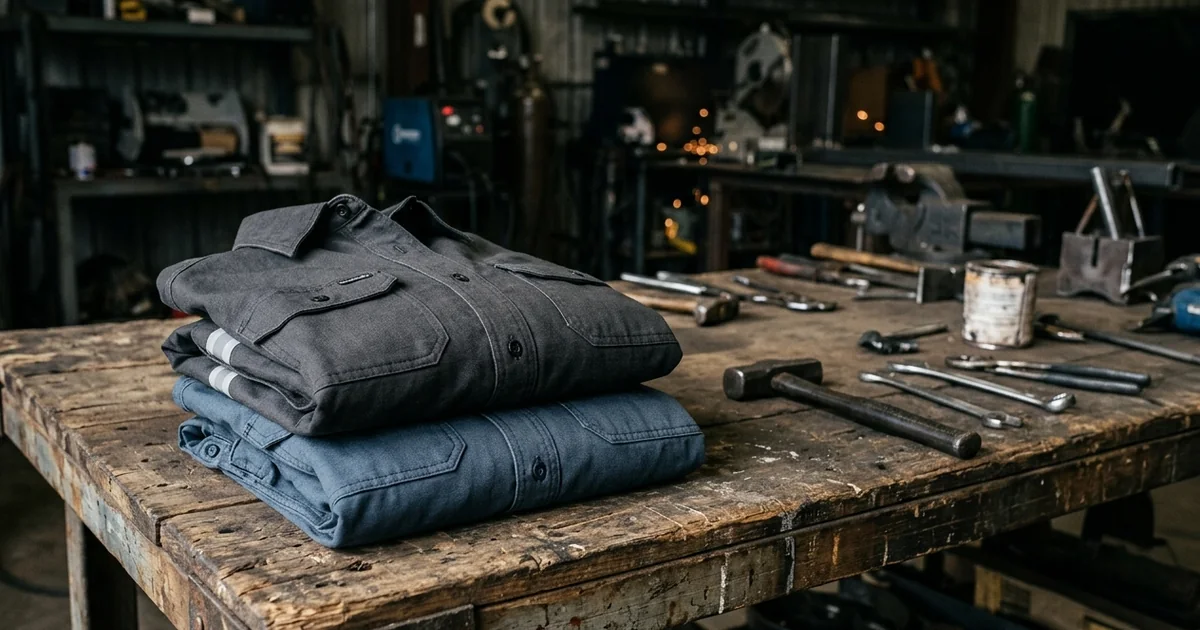
If you want one answer: the Carhartt Women's 104147 FR Force Sun Defender is the women's-cut FR shirt I'd reach for first — it's a true women's fit, the lightest fabric on this list (4.7 oz), and the only pick whose listing states all three of NFPA 2112, NFPA 70E and ASTM F1506. But "best" depends on your hazard and your build: if you need a published arc number you'll want the Wrangler western (9.5 cal/cm²) or the Ariat baselayer (9 cal/cm²); if you want durability over weight, the heavier Carhartt twill wins. FR clothing is fabric that resists ignition, self-extinguishes once the flame source is gone, and won't melt onto your skin — it is not "fireproof." Below I rank five shirts that are actually cut for women, and flag where a "women's" listing is really unisex sizing.
Key Takeaways
- Buy the cut, not just the size. A real women's FR shirt is drafted for women's proportions — many "ladies" listings are just smaller unisex sizing. If fit is your priority, start with the dedicated women's bodies in this guide and my women's FR clothing overview.
- NFPA 2112 and an arc rating are two different things. NFPA 2112 covers flash fire; the arc rating (ATPV in cal/cm²) is separate and only some of these shirts publish it. Don't assume a 2112 shirt has an arc number — see my best FR shirts breakdown.
- Lightest here is the 4.7 oz Carhartt Sun Defender. If summer heat is your real enemy, weight matters more than brand; compare it against my best lightweight FR shirts picks.
- Inherent vs treated changes wash care, not just feel. The Ariat and the Carhartt Sun Defender use inherent FR fibers; the Wrangler and the cotton Carharts are treated. Either way, wash them right — see how to wash FR clothing.
- I only quote a rating the listing states. Where a cal/cm² or ASTM number isn't on the page, you'll see "—" — never a borrowed or invented number.
How I ranked these (protection first, not commission)
I rank on honest merit: protection clarity first, then value, then fit — not on what pays the most. Concretely, I only quote a spec when the product listing actually states it. If a listing publishes an NFPA 2112 classification but no arc rating, I say NFPA 2112 and put "—" in the arc column; I never borrow one model's cal/cm² number for another, and I never invent one. NFPA 2112 means the garment is certified for flash-fire protection; an arc rating (ATPV, in cal/cm²) is a separate measurement that only some of these shirts publish. A no-arc-number shirt isn't "worse" — it just hasn't published that test, so for arc-flash work you confirm the rating on the tag. Fit is judged on whether the shirt is genuinely cut for women versus unisex sizing relabeled. Where a listing is silent, you'll see "not stated" — that's the honest answer, not a gap I'll paper over.
| Pick | Fabric / weight | Arc rating (if stated) | Best for | Price |
|---|---|---|---|---|
| 1. Carhartt 104147 Sun Defender | 4.7 oz FR twill — 50% Lenzing FR / 38% modacrylic / 10% polyamide / 2% anti-stat (inherent fiber in blend) | — (NFPA 2112 + 70E + ASTM F1506 stated; no cal/cm²) | Lightest true women's button-front | $124.99 |
| 2. Ariat Primo Baselayer | 6 oz inherent FR jersey — 50% Modacrylic / 40% Lyocell / 10% Twaron | 9 cal/cm² (CAT 2; NFPA 2112 + 70E stated) | Layering under FR outerwear | $104.95 |
| 3. Wrangler FRLW04 Western | 88% cotton / 12% nylon FR sateen (treated); weight not stated | ATPV 9.5 cal/cm² (HRC 2; NFPA 2112 + 70E, F1506 referenced) | Highest stated arc number + western cut | $85.99 |
| 4. Carhartt 102459 Twill | 7 oz — 87% cotton / 7% hi-tenacity nylon / 5% poly / 1% Spandex (treated) | — (NFPA 2112 + 70E stated; no cal/cm², no ASTM) | Durable everyday work shirt | $84.99 |
| 5. Carhartt 102685 Force Crewneck | 6.75 oz — 100% cotton FR jersey knit (treated) | — (NFPA 2112 + 70E stated; no cal/cm², no ASTM) | Value / under-coverall layer | $77.99 |
1. Carhartt Women's 104147 FR Force Sun Defender — best for a true women's fit at low weight
This is the shirt I'd hand most women first. It's a genuine women's-cut button-front in a 4.7 oz FR twill — the lightest fabric in this guide — and its blend includes Lenzing FR, an inherent FR fiber, alongside modacrylic. It's also the only listing here that states all three of NFPA 2112, NFPA 70E and ASTM F1506. The honest trade-off: it's the most expensive pick, and despite the complete standards line, the listing does not publish an ATPV cal/cm² number, so if your job has a specified arc requirement, verify the cal rating on the garment tag before relying on it.
- Pros: Lightest fabric here (4.7 oz); real women's cut; inherent FR fiber (Lenzing FR) in the blend; states NFPA 2112 + NFPA 70E + ASTM F1506 — the fullest standards story of the five.
- Cons: Priciest at $124.99; no ATPV cal/cm² stated, so the specific arc rating isn't published; the blend is mostly modacrylic/polyamide rather than fully inherent.
Check price at Working Person's Store →
2. Ariat Women's FR Primo Baselayer — best for layering with a stated arc number
If you layer FR under a coverall or jacket, this is the cleanest protection story in the group. The listing states the fabric is inherent FR outright (6 oz inherent FR jersey, 50% modacrylic / 40% lyocell / 10% Twaron) and gives an actual arc rating of 9 cal/cm², plus NFPA 2112 and NFPA 70E. The honest caveat is what it is: a baselayer, not a standalone work shirt, so I rank it as the best layering piece rather than your top-shirt. ASTM F1506 is not stated on the listing, and the FUZE odor treatment is a comfort feature, not a protection one.
- Pros: Inherent FR stated explicitly; publishes a real arc number (9 cal/cm², CAT 2); Twaron in the blend; meets NFPA 2112 + 70E; permanent odor resistance for long shifts.
- Cons: It's a baselayer, not an outer shirt; ASTM F1506 not stated; close-fitting jersey won't suit everyone as a top layer.
Check price at Working Person's Store →
3. Wrangler Women's FRLW04 Western — best for the highest stated arc rating in a women's western cut
For anyone who wants a published arc number on the actual shirt (not a layer underneath), this Wrangler leads: the specs table lists an ATPV of 9.5 cal/cm² — the highest stated number in this guide — along with NFPA 2112, NFPA 70E and a reference to ASTM F1506, all in a real women's western snap-front cut. The trade-off is fabric: it's a treated 88% cotton / 12% nylon FR sateen rather than an inherent blend, and the listing doesn't state the fabric weight, so if you run hot, you're buying somewhat blind on breathability.
- Pros: Highest stated arc rating here (ATPV 9.5 cal/cm², HRC 2); full standards line (NFPA 2112 + 70E, ASTM F1506 referenced); genuine women's western cut; mid-pack price at $85.99.
- Cons: Treated cotton/nylon, not inherent; fabric weight not stated, so heat performance is unclear; western snaps and styling aren't for every jobsite.
Check price at Working Person's Store →
4. Carhartt Women's 102459 Twill — best for durable everyday wear
This is the workhorse. A 7 oz women's twill (87% cotton / 7% high-tenacity nylon / 5% polyester / 1% Spandex) with enough stretch to move in, it meets NFPA 70E and is UL Classified to NFPA 2112 (CAT 2, with the label sewn on the sleeve placket). The honest limitation: the listing states no ATPV cal/cm² and no ASTM F1506, so think of it as a flash-fire shirt first. If your work specifies an arc rating, check the tag rather than assuming one — and at 7 oz it's the heaviest woven here, which is a feature for durability and a drawback in summer heat.
- Pros: Durable 7 oz twill with a touch of Spandex for movement; women's cut; NFPA 2112 + NFPA 70E; reasonable $84.99.
- Cons: No ATPV cal/cm² stated; no ASTM F1506 stated; heaviest woven fabric here, so warmer in heat.
Check price at Working Person's Store →
5. Carhartt Women's 102685 FR Force Cotton Crewneck — best value
The cheapest way into a real women's-cut FR shirt, and the most t-shirt-like to wear here. It's a 6.75 oz 100% cotton FR jersey-knit crewneck that meets NFPA 70E and is UL Classified to NFPA 2112 (CAT 2). The trade-off is the same standards picture as the twill: no ATPV cal/cm² and no ASTM F1506 are stated, so it's flash-fire protection rather than a stated arc-rated layer. As 100% cotton it's comfortable and breathable for the weight, but cotton FR holds moisture, so it shines as an under-coverall layer or a warm-weather standalone where no specific arc number is required.
- Pros: Lowest price at $77.99; soft 100% cotton FR knit; comfortable crewneck cut for layering; NFPA 2112 + NFPA 70E.
- Cons: No ATPV cal/cm² stated; no ASTM F1506 stated; 100% cotton FR retains moisture and isn't the lightest knit option.
Check price at Working Person's Store →
Is a "women's" FR shirt really cut for women, or just smaller unisex?
This is the trap to watch. A genuine women's FR shirt is drafted for women's proportions — shaped through the waist, set for narrower shoulders, with sleeve and torso lengths to match. A lot of "ladies'" FR listings are simply the unisex body in smaller sizes, which is why so many fit boxy or long in the sleeve. The five shirts above are all marketed as women's bodies; where I have any doubt about a fit claim, I say so rather than promise a cut the listing doesn't substantiate. Fit isn't cosmetic on FR gear, either: a shirt that's too loose adds snag risk and a shirt pulled tight loses the air gap that helps it protect, so the right cut is a safety feature, not just comfort.
Frequently Asked Questions
Does NFPA 2112 mean a shirt is arc-rated?
No. NFPA 2112 certifies flash-fire protection; an arc rating (ATPV, measured in cal/cm²) is a separate test. Some shirts publish both, some only NFPA 2112. In this guide the Wrangler (9.5 cal/cm²) and Ariat (9 cal/cm²) state an arc number; the others state NFPA 2112 but no cal/cm², shown as "—."
Which of these is the lightest / coolest for summer?
By stated fabric weight, the Carhartt 104147 Sun Defender is lightest at 4.7 oz, followed by the Ariat baselayer at 6 oz and the Carhartt 102685 cotton crewneck at 6.75 oz. The Wrangler western does not state a fabric weight, so I can't rank it on weight.
Which are inherent FR and which are treated?
The Ariat baselayer states it's inherent FR, and the Carhartt 104147 blend includes Lenzing FR, an inherent fiber. The Wrangler (cotton/nylon sateen) and the two cotton Carharts are treated FR. Inherent FR is built into the fiber; treated FR is a chemical finish on the fabric.
What does CAT 2 mean for these shirts?
PPE Category (CAT) maps to a minimum arc rating: CAT 1 is ≥4 cal/cm², CAT 2 is ≥8, CAT 3 is ≥25, CAT 4 is ≥40 cal/cm². Several of these list CAT 2 / HRC 2. Always match the garment's rating to your site's arc-flash assessment rather than assuming the category covers your task.
Can I wash these FR shirts at home?
Generally yes, but how you wash them matters — chlorine bleach, fabric softener and high heat can degrade FR performance over time, especially on treated fabrics. Follow each garment's care tag and see my guide on how to wash FR clothing for the specifics.
Why Trust This Guide
This guide was written and reviewed by Wes Calder, an independent flame-resistant-workwear reviewer. My authority is method, not a sales floor: I read the standards, pull each garment's published spec sheet, and quote only the NFPA 2112, NFPA 70E, ASTM F1506 and arc/ATPV figures the listing actually states — marking everything else "—" rather than guessing. I rank on protection, fit and value, and a shirt that pays no commission can still outrank one that does when it genuinely protects or fits better. We earn a commission on some links, but never rank by commission over safety — see our affiliate disclosure.