
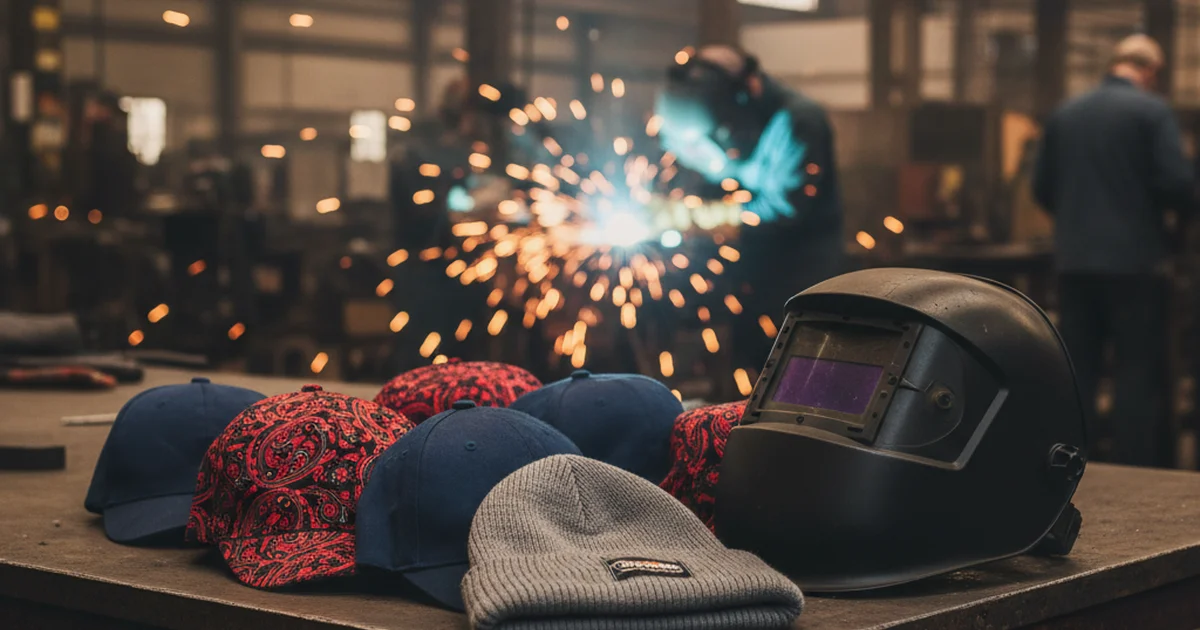
The best FR welding caps stop two things a bare bandana won't: a spark rolling down your collar and a slag burn cooking your scalp under the hood. For most welders I'd reach for the PIP 9100-HDFR12 balaclava — it's the only head cover in this set with a real listed arc rating (ATPV 12.1 cal/cm², CAT 2) and it still breathes. If you want a traditional cap shape with a brim, the Benchmark GOAT Flex is the honest pick. What is an FR welding cap? A flame-resistant head cover worn under the hood that resists ignition, self-extinguishes, and won't melt onto your skin — not a "fireproof" cap.
Key Takeaways
- Arc-rated ≠ just FR: all arc-rated head covers are flame-resistant, but not all FR caps are arc-rated. For an electrical arc-flash hazard you need a cal/cm² number (the PIP's 12.1 cal or Benchmark's 6 cal), not just "FR."
- Inherent vs treated matters on your head: the PIP, Carhartt and Benchmark covers are inherent FR (the fiber itself is FR and won't wash out); several cotton caps don't state inherent vs treated, so confirm before you rely on them.
- Only one here is NFPA 2112-confirmed: the Carhartt FR Force Balaclava is UL classified to NFPA 2112 on its listing — most of these caps state no third-party cert at all.
- Shrink and fit are the real complaints: cotton caps can tighten after a few hot washes; balaclavas with spandex hold shape better but trade away durability.
- A cap is the last 5% of coverage, not the whole system: it protects what your hood and collar miss. Match the cap's protection to the same hazard your shirt and pants are rated for, not a level below.
How I evaluated these caps — what actually matters on your head
A welding cap is a small piece of gear that sits in the worst possible place: directly under the hood, soaking up sweat, sparks, and the heat that radiates off the work. I don't lab-test these — I read the listings and tags, pull the stated specs, and weigh them against what welders actually complain about. Here's the honest criteria I used to rank this set, in roughly the order I'd weight them for a welder.
- Does the protection match the hazard? This is the first filter and it splits the field in two. A pure spatter job needs a flame-resistant cap that self-extinguishes — nothing more exotic. An electrical or arc-flash job needs a stated arc rating in cal/cm² that meets your NFPA 70E PPE Category. "FR" on the tag does not equal an arc rating; only a published ATPV or EBT number does. Two covers here give you one, four don't.
- Inherent vs treated FR. Inherent FR means the fiber itself is flame-resistant — modacrylic, aramid — so it can't wash out no matter how badly you launder it. Treated FR is a flame-resistant finish on cotton; done right it lasts the garment's useful life, but it depends on correct laundering. On a head cover that gets sweated through and washed hard, I lean toward inherent unless the cotton cap states a durable, certified treatment. Several caps here simply don't say which they are, and I won't guess.
- Fabric weight and layer count. Weight (oz) is a proxy for two competing things: spatter resistance and how hot the cap runs. Heavier and multi-layer resists burn-through better but cooks your head; lighter and single-layer breathes but gives up durability. Where a listing states the weight I tell you; where it doesn't, I say "—" rather than invent a number.
- Third-party certification. NFPA 2112 is the flash-fire garment standard, and a UL classification to it is a real, independent mark — not a marketing line. Most welding caps carry no third-party cert at all, which is fine for spatter but means you can't lean on them where a site mandates a cert. I flag the one cover here that's actually classified.
- Fit and coverage geometry. A balaclava that tucks below the neckline closes the collar gap a brimmed cap physically cannot. A 6-panel cap with a brim flings slag off your face and runs cooler. One-size-fits-all is a real limitation on a tool you wear all day — I treat it as a con, not a feature.
- Spatter durability and seams. Minimal seams, secure elastics, and a shape that stays put under the hood matter more than they sound. A cap that slides back every time you tip your head forward is a cap you stop wearing.
- Breathability. The cap you actually keep on is the one that doesn't make your scalp swim. This is where single-layer and knit blends earn their keep, and where heavy double-layer cotton pays a comfort tax.
- Care and washability. FR is only FR if you launder it right. Inherent fiber is more forgiving; treated cotton is less. I factor in how punishing the cap will be to keep in spec over a year of hard washes.
One thing I won't do: tell you I burn-tested these or wore each one for six months. I haven't. The ranking is built on the stated specs, the standards behind them, and the patterns welders report — and I tell you plainly every time a listing leaves a number blank.
Welding cap or balaclava — which do you actually need?
The fastest way to choose is by what's burning you. If sparks keep finding the gap between your collar and your neck, a balaclava that tucks below the neckline (PIP or Carhartt) solves it in a way no brimmed cap can. If your problem is slag landing on your crown and forehead and you hate the hot, wrapped-up feel of a hood, a 6-panel cap with a brim (Benchmark GOAT Flex, LAPCO) keeps your head cooler and channels spatter off your face.
There's a comfort dimension too. A balaclava is more coverage but more heat and a more claustrophobic feel — some welders can't stand the wrapped-up sensation under an already-hot hood. A cap is cooler and less confining but leaves your neck and lower face exposed to whatever rolls past the brim. Neither is universally "more protective"; they protect different real estate.
One thing I won't fudge: a "welding cap" is not automatically an arc-rated garment. Most of the caps below are spatter protection — genuinely FR, but with no cal/cm² number on the listing. If you work an electrical/arc-flash job, you need a stated arc rating, and only two covers here give you one.
| Pick | Fabric / weight | Inherent / treated | NFPA 2112 | Rating (if stated) | Real-world catch | Price |
|---|---|---|---|---|---|---|
| PIP 9100-HDFR12 Balaclava | 86% cotton / 12% nylon / 2% spandex; 6.5 oz single layer | Inherent | — | ATPV 12.1 cal/cm², CAT 2 | Single layer — comfy, but less durable than multi-layer | $49.99 |
| Carhartt FR Force Balaclava | 45% modacrylic / 35% lyocell / 20% aramid; 6.75 oz knit | Inherent | UL classified | — | NFPA 2112 confirmed, but no cal/cm² listed | $42.99 |
| Black Stallion BC5W-BK Cap | Cotton FR; weight — | Not stated | — | — | One-size-fits-all; no weight/cert/arc stated | $7.99 |
| Benchmark GOAT Flex Cap | Silver Bullet FR + GOAT Flex blend, double layer; oz — | Inherent | — | ATPV 6 cal/cm², CAT 1 | Larger sizes go OOS; no oz / NFPA 2112 stated | $28.99 |
| Benchmark 3035FRN Beanie | Inherent FR blend; oz — | Inherent | — | 36 cal/cm² (EBT), Level 3 | Currently backordered; fiber/oz not given | $29.99 |
| LAPCO 6-Panel Cap | 100% cotton FR; 7 oz | Not stated | — | — | No NFPA 2112, no arc rating, inherent vs treated unstated | $17.13 |
1. PIP 9100-HDFR12 Balaclava — best arc-rated under-hood cover
This is the one I'd put on my own head if my job had any electrical exposure. It's the only head cover in this group with a real, listed arc rating — ATPV 12.1 cal/cm², CAT 2 — and the fiber is inherent FR (86% cotton / 12% high-tenacity nylon / 2% spandex), so it won't wash out the way a treated finish can degrade if you launder it wrong. At 6.5 oz single layer it's thin enough to wear all day without cooking, and the spandex keeps it from sagging.
Who it's for: the welder who's also working around energized equipment, or anyone on a jobsite that mandates an arc rating on every layer including the head cover. At 12.1 cal it clears CAT 2 (≥8 cal) with margin, so it's the cover here you can actually point to on an electrical job, not just a spark job.
The real trade-off: single-layer construction is what makes it breathe, and it's also what limits its lifespan in heavy abrasive use — you're buying comfort and a verified rating, not maximum spatter durability. The VOC pain it solves is the most common balaclava complaint: covers that turn into a sweat-soaked sauna by mid-shift. The thin inherent knit with spandex is the answer to that, while still carrying the highest verified number in this group.
- Pros: Highest verified arc rating here (12.1 cal, CAT 2); inherent FR that won't wash out; breathable next-to-skin feel for daily wear.
- Cons: Single-layer 6.5 oz construction is comfortable but won't outlast a multi-layer cap in heavy, abrasive use; at $49.99 it's the priciest cover in the set.
Check price at Working Person's Store →
2. Carhartt FR Force Balaclava — best NFPA 2112-confirmed face cover
If you want a name you already trust and a cert you can point to, this is it. It's the only head cover here that's UL classified to NFPA 2112 on its listing, and it's inherent FR — a 45% modacrylic / 35% lyocell / 20% aramid pique knit (6.75 oz) that won't lose its FR over time. Full-face coverage drops below the neckline, so it closes the collar gap and the modacrylic blend feels softer against the skin than straight cotton.
Who it's for: oil-and-gas and flash-fire-exposed welders who need a head cover their site's NFPA 2112 program will actually accept. The UL classification is the thing the PIP doesn't have — if your hazard is flash fire and your paperwork wants a 2112-classified garment on your head, this is the straightforward answer.
The real trade-off: it nails the flash-fire side and whiffs on the arc-flash side. The listing states no cal/cm² number, so for an arc-flash job you can't confirm a CAT level — and you should never assume one from the fact that it's FR. The VOC pain it solves is the modacrylic comfort gap: welders who find cotton balaclavas scratchy and stiff against a sweaty face tend to rate modacrylic/aramid knits more comfortable. Just buy it for what it documents — flash fire and spatter — not for a rating it doesn't print.
- Pros: UL classified to NFPA 2112; inherent modacrylic/aramid that won't wash out; full below-the-neckline coverage from a brand with a long FR track record.
- Cons: The listing states no cal/cm² arc rating, so for an arc-flash job you can't confirm the protection level — treat it as flash-fire and spatter coverage, not a verified arc garment.
Check price at Working Person's Store →
3. Black Stallion BC5W-BK Flame Armor Cap — best cheap shop staple
At $7.99 this is the cap I'd buy by the handful and keep in a drawer. It's a double-layer construction with side elastics, so it actually stays put, and it's a proper welding cap shape for guys who don't want a wrapped-up balaclava feel. Be clear-eyed about what it is, though: the listing states no fabric weight, no NFPA 2112, and no arc rating, so this is spatter protection, full stop — not a rated arc or flash-fire garment.
Who it's for: the hobbyist, the shop that goes through caps like shop rags, and the welder who wants a backup in the truck. When the only hazard is spatter and you'd rather own five caps than baby one, the price-to-protection math here is hard to beat.
The real trade-off: you're trading documentation for price. The double-layer build is genuinely more spark-resistant than a thin single-layer cap, but with no stated weight, cert, or rating you can't put it anywhere a spec sheet is required, and one-size-fits-all means it'll be loose on a small head and tight on a big one. The VOC pain it solves is the eternal "I keep losing or burning through caps" gripe — at eight bucks, you just grab another.
- Pros: Cheapest in the set; double-layer with side elastics for a secure fit; from my primary retailer, so easy to restock.
- Cons: Page lists no weight, no NFPA 2112, and no arc rating; one-size-fits-all won't suit every head.
Check price at Working Person's Store →
4. Benchmark GOAT Flex Welding Cap — best true 6-panel cap
If you want a real welding cap — brim and all — with a rating you can actually cite, this is my pick. It's a true 6-panel cap (not a balaclava) with minimal seams, an extra-wide brim that flings slag off your face and neck, and a stated ATPV of 6 cal/cm² (CAT 1), which most caps don't bother to publish. The blend is inherent FR (Silver Bullet FR over a GOAT Flex layer), double-layered, and Benchmark is one of the few makers here with a verified U.S. home base (Santa Ana, CA, est. 2002).
Who it's for: the old-hand welder who wants the classic 6-panel shape and the brim, but isn't willing to give up a stated rating to get it. It threads a needle most caps don't — traditional cut and a published CAT 1 number on the same tag.
The real trade-off: 6 cal/cm² clears CAT 1 (≥4 cal) but not CAT 2 (≥8 cal), so it's a lower arc number than the PIP's 12.1 — if your job demands CAT 2 on the head, this isn't it. And the page states no fabric weight and no NFPA 2112, so it's a documented arc rating but an undocumented flash-fire cert. The VOC pain it solves is the classic cap complaint: bare cotton caps with no rating and a floppy brim that lets slag past. Benchmark answers both — a stiff wide brim and a number you can cite. Just mind that larger sizes go out of stock.
- Pros: Genuine 6-panel cap shape with a wide brim; stated 6 cal CAT 1 arc rating; inherent double-layer FR from a verified Santa Ana, CA maker.
- Cons: No fabric oz weight or NFPA 2112 stated on the page; larger sizes (2XL) can be out of stock.
5. Benchmark 3035FRN FR Beanie — best high-rating cold-weather pick
This isn't an under-hood cap; it's the head cover for outdoor cold work — a yard, a tank farm, cold storage — where you want warmth and protection together. The standout number is a 36 cal/cm² EBT (Arc Level 3), which is genuinely high, paired with a double-wall knit that holds heat and has good stretch and recovery. It's inherent FR. Just know its limits: it's a beanie shape, not a brimmed welding cap, and it's the one pick here you may have to wait on.
Who it's for: the outdoor electrical or oilfield worker pulling winter shifts who needs a head cover that's both warm and high-rated. At 36 cal EBT it clears CAT 3 (≥25 cal) — the highest number in this entire group — so it earns its spot for the cold arc-flash job, not the welding booth.
The real trade-off: a beanie isn't a welding cap. There's no brim to channel slag off your face, and the knit shape isn't built to sit cleanly under a hood, so don't buy it expecting under-hood spatter performance — buy it for warmth plus a serious arc rating in the cold. The VOC pain it solves is the genuine one of cold-weather FR workers stuck choosing between warm-but-flammable beanies and rated-but-thin covers. The catch is availability: it's currently backordered with no stated restock date, and exact fiber and oz aren't given on the listing.
- Pros: High 36 cal/cm² (EBT) Level 3 rating; warm double-wall knit with good stretch/recovery; inherent FR.
- Cons: Currently backordered with no stated restock date; exact fiber composition and oz weight aren't given on the listing.
Check price at fireretardantshirts.com →
6. LAPCO 6-Panel FR Welding Cap — most traditional budget cap
The LAP-6CFR is the classic low-crown 6-panel cotton welding cap — the shape a lot of old-hand welders have worn for decades — at a fair $17.13 from a dedicated FR brand. It's a 7 oz 100% cotton cap, which is the familiar, breathable feel most welders expect. The honest catch is the spec sheet: the listing states no NFPA 2112, no arc rating, and doesn't say whether the FR is inherent or treated, so don't lean on it for anything past spatter, and confirm the cert if your site mandates one.
Who it's for: the traditionalist who wants the familiar low-crown cotton cap and a real fabric weight on the tag, and whose only hazard is spatter. At 7 oz of cotton it's the breathable, broken-in feel a lot of welders grew up on.
The real trade-off: it's the most documented of the budget caps on fabric weight (7 oz, stated) but the least documented on protection — no cert, no rating, and no word on whether the FR is inherent or a treatment. That matters because 100% cotton is exactly the fiber that's usually treated rather than inherently FR, and a treated finish lives or dies by correct laundering. The VOC pain it solves is comfort and familiarity — the welder who can't stand stiff modacrylic and wants the cotton cap shape he's always worn. Just verify the spec sheet before you trust it anywhere past sparks.
- Pros: Traditional low-crown 6-panel shape; 7 oz cotton breathes; budget price from a dedicated FR brand.
- Cons: No NFPA 2112, no arc rating, and inherent vs treated unstated on the page — verify the spec sheet before relying on it.
How to choose an FR welding cap
Past the cap-vs-balaclava split, here's the order I'd actually walk through a buying decision in, from the question that disqualifies products fastest to the ones that just fine-tune the pick.
1. Start with your hazard, not the cap. Pure welding spatter? Any genuinely FR cap that self-extinguishes does the core job — you're optimizing for fit and comfort from there. Electrical or arc-flash exposure? Now you need a stated arc rating that meets your NFPA 70E PPE Category, and the field narrows to the PIP (12.1 cal, CAT 2), the Benchmark GOAT Flex (6 cal, CAT 1), and the Benchmark beanie (36 cal EBT, Level 3) — the three covers here that print a number. The minimum arc ratings are CAT 1 ≥4, CAT 2 ≥8, CAT 3 ≥25, CAT 4 ≥40 cal/cm². Don't round up an unrated cap to a category it never claimed.
2. Don't let the head cover undercut the rest of your PPE. If your shirt and pants are arc-rated to CAT 2, a CAT 1 or unrated cap is the weak link in the system at exactly the spot — your face and scalp — where a burn is worst. The cap should match, not drop a level below, the hazard you've already dressed for everywhere else.
3. Decide on coverage geometry. Collar gap getting you? Balaclava. Slag on the crown and you hate feeling wrapped up? Brimmed cap. There's no universally "more protective" answer — they protect different skin, and the right one is the one you'll actually keep on for a full shift.
4. Inherent vs treated, and what you can verify. Inherent FR (modacrylic, aramid) can't wash out and is the safer default for a sweated-through cap laundered hard. Treated cotton is fine when the listing states a durable, certified treatment — but when a cotton cap says nothing about inherent vs treated, treat that silence as a gap to confirm, not a detail to assume away.
5. Weigh comfort honestly. The cap you keep on protects you; the one in your back pocket protects nothing. Heat, breathability, and fit (one-size-fits-all is a real limitation) decide whether the cap stays on your head when the shop hits 95°F. A slightly lower-rated cap you wear every minute beats a higher-rated one you yank off.
6. Plan for laundering and lifespan. Buy with a little room if it's cotton, since hot washes can shrink it. Then keep it in spec: no chlorine bleach, no fabric softener, no hydrogen-peroxide bleach, no starch — they degrade FR or leave flammable residue. A cap saturated with grease or oil is a fire hazard regardless of its FR rating; clean it or retire it.
Frequently Asked Questions
Does a welding cap need an arc rating?
For pure welding spatter, no — you need a flame-resistant cap that self-extinguishes. But if your job also has an electrical arc-flash hazard, "FR" alone isn't enough: you need a stated arc rating in cal/cm² that meets your NFPA 70E PPE Category (CAT 1 ≥4, CAT 2 ≥8, CAT 3 ≥25, CAT 4 ≥40). Match the head cover to the actual hazard, not the label.
Is an inherent FR cap better than a treated cotton one?
Inherent FR means the fiber itself is flame-resistant (modacrylic blends, aramids) and won't wash out — an advantage for a cap that gets laundered hard and sweated in. Treated FR is a chemical finish on cotton, engineered to last the garment's useful life if you launder it correctly. Both can certify to NFPA 2112. Inherent usually costs more; treated cotton often feels more familiar to welders.
How do I wash an FR welding cap without shrinking or ruining it?
Wash inside-out with normal detergent and follow the garment's care label. Avoid chlorine bleach, fabric softener, hydrogen-peroxide bleach, and starch — they degrade FR or leave flammable residue. Many makers suggest warm water (around 140°F) to flush oils; hard water can deposit minerals that reduce FR, so an extra rinse helps. Cotton caps can tighten after hot washes, so buy with a little room.
Welding cap or FR balaclava — which protects more?
A balaclava covers more skin: it tucks below the neckline and closes the collar gap that lets sparks roll down your back, which a brimmed cap can't. A 6-panel cap keeps your head cooler, gives you a brim to channel slag off your face, and feels less claustrophobic. Choose by what's actually burning you, and by whether you need a stated arc rating.
Is an FR welding cap fireproof?
No. FR is flame-resistant, not fireproof — it resists ignition, self-extinguishes when the heat source is removed, and won't melt onto your skin, but it is not invincible. A cap saturated with grease or oil becomes a fire hazard regardless of its FR, so clean it or retire it. Garment-lifespan numbers some makers cite are owner-reports, not guarantees.
What's the difference between NFPA 2112 and NFPA 70E for a head cover?
NFPA 2112 is the flash-fire garment standard, common in oil and gas, verified by a manikin burn test and certified at the garment level — a UL classification to it (like the Carhartt balaclava's) is a real third-party mark. NFPA 70E is the electrical-safety standard that defines arc-flash PPE Categories CAT 1-4 by minimum arc rating. A flash-fire job points you to 2112; an arc-flash job points you to a cal/cm² arc rating. They answer different hazards.
What does the cal/cm² arc rating on a cap actually mean?
It's the garment's arc rating — expressed as ATPV or EBT, both in cal/cm² — and the higher the number, the more arc energy the fabric can take before a predicted second-degree burn or breakopen. When a garment lists both ATPV and EBT, its rating is the lower of the two. The PIP cap's 12.1 cal clears CAT 2 (≥8), the Benchmark GOAT Flex's 6 cal clears CAT 1 (≥4), and the Benchmark beanie's 36 cal EBT clears CAT 3 (≥25). Caps with no number stated aren't arc-rated.
How long does an FR welding cap last?
There's no fixed expiration; it depends on the fiber, how it's laundered, and the abuse it takes. Inherent FR (modacrylic, aramid) won't lose its flame resistance from washing, while treated cotton depends on correct laundering to hold its finish over the garment's life. The 18-to-30-month figures you'll see floating around are owner-reports, not a rated lifespan. The real retirement trigger is condition: holes, worn-thin spots, or grease and oil saturation mean it's done, regardless of age.
Why Trust This Guide
This guide is written and reviewed by Wes Calder, an independent flame-resistant-workwear reviewer. Every recommendation is built on the published standards (NFPA 2112, NFPA 70E, ASTM F1506), manufacturer spec sheets and garment tags, hands-on handling, and what tradespeople actually report — and we tell you when a number is a manufacturer claim versus an independent standard, and when a garment is FR but not arc-rated. We earn an affiliate commission if you buy through some of our links, at no extra cost to you, and we never rank by commission over safety — see our affiliate disclosure.