
Why do arc flashes happen? An arc flash happens when electric current jumps the air gap between energized conductors — or from a conductor to ground — instead of staying on its intended path, releasing a burst of heat, light, and pressure in a fraction of a second. That instant of fault is the whole reason arc-rated clothing exists: the cal/cm² number on your gear is the amount of thermal energy the garment is rated to take before you'd reach the threshold of a second-degree burn underneath it. If you've ever wondered what that abstract rating is actually defending you against, this is it.
I'll keep this general and non-clinical. The point isn't to dramatize the injury — it's to make the cal rating real, so the next time you read "ATPV 8 cal/cm²" on a tag, you understand the hazard it was measured against.
Key Takeaways
- An arc flash is a fault, not a shock: current arcs through the air across an unintended path, dumping heat and energy in milliseconds — the hazard is thermal and concussive, not just electrocution.
- Most are triggered by something small: a dropped tool, a loose connection, condensation, dust, a rodent, or a slipped probe can bridge the gap and start the fault.
- The injuries are thermal: the arc's primary harm is intense radiant heat causing burns, compounded by a pressure blast and flying debris — your FR layer's job is to resist ignition and not melt onto skin.
- The cal rating is the link: NFPA 70E defines arc-flash PPE Categories CAT 1–4, and the garment's arc rating (ATPV or EBT in cal/cm²) is what's matched to the hazard.
- FR alone isn't arc-rated: all arc-rated clothing is flame-resistant, but not all FR clothing carries an arc rating — an arc-flash hazard needs a cal/cm² number, not just "FR."
What actually is an arc flash?
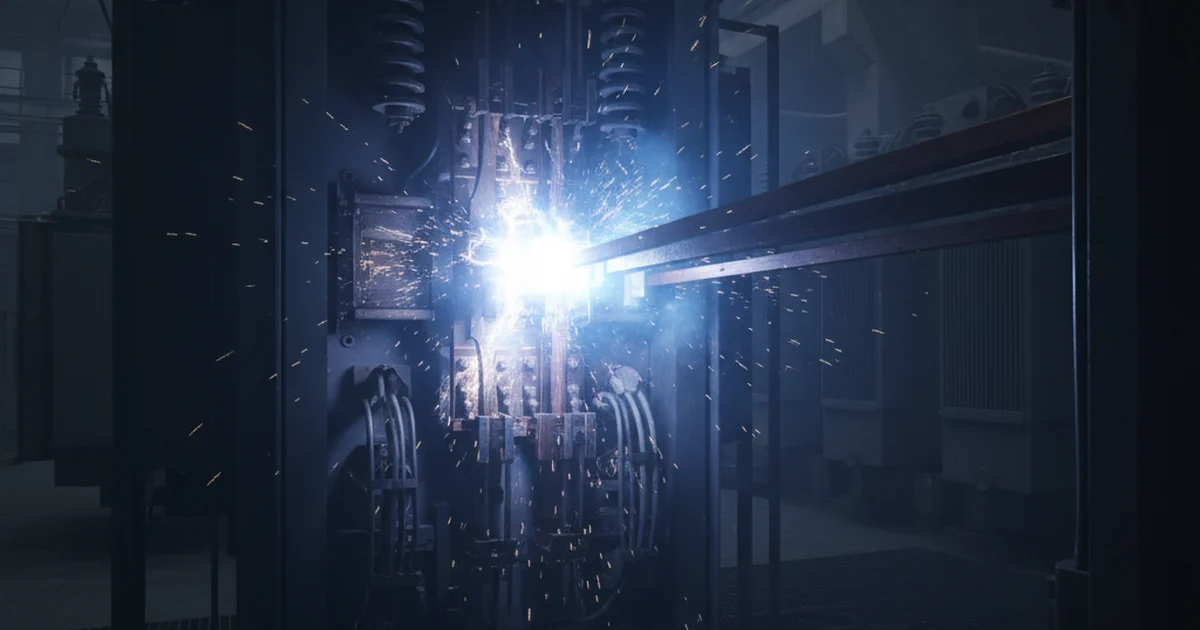
In normal operation, electricity stays inside conductors — wires, busbars, terminals — and air is an insulator that keeps those conductors apart. An arc flash is what happens when that insulation fails and current finds a path it was never meant to take: it arcs across the air gap. Air doesn't conduct easily, so forcing current through it produces an enormous release of energy as heat and light in a very short time.
It helps to separate two related hazards. Electric shock is current passing through your body. An arc flash is the thermal-and-pressure event that radiates outward from the fault — you don't have to be touching anything to be burned by it. That's why arc-flash PPE is built around resisting heat and flame, while shock protection (insulating gloves, lockout/tagout, de-energizing) is a separate layer. The two often get lumped together as "electrical safety," but the clothing you wear is fighting the arc-flash side of it.
Why do arc flashes happen — the real triggers
The honest answer most workers don't expect: arc flashes are rarely caused by something dramatic. The fault usually starts when something bridges the gap between energized parts or between a conductor and ground, giving current the unintended path it needs. Common real-world triggers include:
- A dropped or slipped tool — a wrench, screwdriver, or probe that touches across two conductors inside live equipment.
- Loose or corroded connections — a poor termination heats up, degrades, and eventually faults.
- Insulation breakdown — worn, cracked, or overheated insulation that no longer keeps conductors apart.
- Contamination — dust, metal filings, moisture, or condensation accumulating where it can create a conductive bridge.
- Animals and debris — a rodent, an insect nest, or foreign material getting into enclosures and switchgear.
- Human error during work on or near energized equipment — the reason de-energizing and proper procedure matter so much.
The pattern across all of these: a small, often invisible failure gives current a shortcut. Once the arc initiates, it can sustain and escalate fast, which is why the hazard is measured in milliseconds and why the response — the clothing — has to work instantly, not "eventually."
What injuries does an arc flash inflict?
I'm going to stay general here on purpose — no fabricated statistics, no case studies, no clinical specifics. What's worth understanding is the nature of the harm, because that's what the gear is engineered against. An arc flash injures in three overlapping ways:
- Radiant and conductive heat (the primary hazard). The arc produces intense heat that can cause thermal burns to exposed skin and can ignite ordinary clothing. This is the harm the cal/cm² rating is built to address — and it's why a non-FR shirt is so dangerous: it can ignite and keep burning, or melt onto skin, long after the arc itself is gone.
- Pressure and blast. The rapid energy release can produce a pressure wave and propel molten material and debris outward. Arc-rated clothing is rated for the thermal exposure; the blast and flying-object side is why face shields, hoods, and the rest of the PPE system exist alongside the garment.
- Light and sound. The flash is extremely bright and loud, which is why eye and hearing protection are part of a complete arc-flash kit, not optional extras.
The takeaway isn't to frighten anyone — it's to connect the dots. FR clothing is not fireproof. What it does is resist ignition, self-extinguish, and refuse to melt onto your skin, so a survivable thermal event doesn't become a far worse one because your clothing kept burning. That distinction — resists ignition vs. fireproof — is the single most important thing to understand about why these garments are rated the way they are.
How the cal/cm² rating connects to the hazard
Here's where the abstract number becomes concrete. NFPA 70E is the electrical-safety-in-the-workplace standard that defines arc-flash PPE Categories — CAT 1 through CAT 4 — based on the severity of the hazard at a given task. Each category carries a minimum arc rating for the clothing system:
| PPE Category | Minimum arc rating |
|---|---|
| CAT 1 | ≥ 4 cal/cm² |
| CAT 2 | ≥ 8 cal/cm² |
| CAT 3 | ≥ 25 cal/cm² |
| CAT 4 | ≥ 40 cal/cm² |
The garment's arc rating — expressed as ATPV or EBT, both in cal/cm² — is what gets matched to that category. When a garment lists both values, the published arc rating is the lower of the two; higher is more protective. So a shirt rated at 8 cal/cm² is rated to take roughly twice the thermal energy of one at 4 cal/cm² before reaching the second-degree-burn threshold. That's the entire reason the number matters: it's the measured wall between the arc's heat and your skin.
One more standards note that trips people up: the term "HRC" (Hazard Risk Category) was renamed "PPE Category / CAT" in the 2015 edition of NFPA 70E, which also dropped the old HRC 0 — leaving the CAT 1–4 you see today. If you're reading older charts or hand-me-down training material, that's why the labels don't match. And the fabric/apparel spec that governs FR + arc-rated clothing for electrical workers is ASTM F1506; the flash-fire garment standard for hazards like oil and gas is the separate NFPA 2112, tested with the ASTM F1930 manikin. Different hazard, different standard — same underlying idea that the clothing has to be measured, not assumed.
Frequently Asked Questions
Is an arc flash the same as an electric shock?
No. An electric shock is current passing through your body. An arc flash is a thermal-and-pressure event that radiates outward from a fault, and it can burn you without any direct contact. Shock protection (de-energizing, insulating gloves) and arc-flash protection (arc-rated clothing) are separate layers of electrical safety, addressing different parts of the same job.
Is FR clothing enough for an arc-flash hazard?
Not by itself. All arc-rated clothing is flame-resistant, but not all FR clothing is arc-rated. An arc-flash hazard requires a garment with a stated arc rating in cal/cm² (ATPV or EBT), matched to the NFPA 70E PPE Category for the task. "FR" on a tag with no cal/cm² rating tells you it resists ignition, not that it's qualified for an arc-flash exposure.
What does the cal/cm² number actually mean?
It's the garment's arc rating — the amount of thermal energy the fabric is rated to take before you'd reach the threshold of a second-degree burn underneath it. Higher is more protective. When a garment lists both ATPV and EBT, its published rating is the lower of the two values. NFPA 70E maps these ratings to CAT 1–4 minimums of 4, 8, 25, and 40 cal/cm².
Does arc-rated clothing make me fireproof?
No — FR clothing is not fireproof, and no garment makes you immune to an arc flash. What arc-rated FR does is resist ignition, self-extinguish, and refuse to melt onto skin, so a survivable thermal event doesn't worsen because your clothing kept burning. It's protection rated to a measured limit, not invulnerability. The rest of the PPE system handles the blast, light, and shock hazards.
Why do some charts say HRC instead of CAT?
Because the terminology changed. NFPA 70E renamed "HRC" (Hazard Risk Category) to "PPE Category / CAT" in its 2015 edition, which also dropped the old HRC 0, leaving CAT 1–4. Older training material and labels still use HRC, but the underlying minimum arc ratings — 4, 8, 25, and 40 cal/cm² — are what you match a garment to today.
Why Trust This Guide
This guide is written and reviewed by Wes Calder, an independent flame-resistant-workwear reviewer. Every recommendation is built on the published standards (NFPA 2112, NFPA 70E, ASTM F1506), manufacturer spec sheets and garment tags, hands-on handling, and what tradespeople actually report — and we tell you when a number is a manufacturer claim versus an independent standard, and when a garment is FR but not arc-rated. We earn an affiliate commission if you buy through some of our links, at no extra cost to you, and we never rank by commission over safety — see our affiliate disclosure.